U.S. Energy Investment Services

The prospects for excellent returns from a direct investment in domestic wells are the best in many years with annual returns exceeding all time highs.

U.S. Energy Investment Services will send you information regarding the strongest performing direct investment opportunities with the finest established domestic oil and gas producers, currently seeking investors for direct participation in multiple oil well and gas programs in proven domestic oil and gas fields, this includes Green Fuel and other alternative fuel solutions.

U.S. Energy Investment Services will send you details on the finest established U.S. Oil and Gas firms, with proven track records of drilled successful producing Oil and Gas wells all over the USA. Fill out the Energy Investor Evaluation to receive details about these firms current direct participation opportunities.


Tax Incentives
Under the current tax code, the most favored investment is drilling for oil and gas. Development of natural gas and oil from domestic reserves helps to make our country more self sufficient by reducing our dependence on foreign imports so Congress provides tax incentives to stimulate this production by private sources. Many investments, which were previously thought of as tax shelters were reclassified under the Tax Reform Act of 1986 as “passive” activities (a business in which the taxpayer does not actively participate). The significant exception to this rule is drilling for oil and natural gas. It is specifically stated as NOT being a passive activity.

So what does this mean to you?

It means that as an investor in oil and gas drilling, one would have significant tax write offs. The first and largest write off is the Intangible Drilling Costs (IDC). Intangible Drilling Costs are expenses that are incurred during the drilling and developing of a well such as labor, testing, geological studies etc. Equipment, however, is excluded, as it is tangible. Usually 70-80% of the investment pays for intangible drilling costs and these can be written off in the year that they occur. Tangible Costs include well equipment and is depreciated over a 7 year period.

As each project and each company is structured differently, please see your personal tax advisors to see how these apply to your particular situation.

India close to solar energy breakthrough

SOLAR cells used to tap energy from the sun are made up of photovoltaic substances such as silicon which, when combined with suitable additives and exposed to sunlight, produce electricity. Extracting crystalline silicon from the compounds in which it is found is highly energy-intensive and the element itself accounts for upto 50 per cent of the total cost of producing photovoltaic systems. Crystalline silicon for photovoltaic applications costs about Rs 1500 (US $50) per kg in the global market. A little over 25 gms of monocrystalline wafers is required to produce one watt of electricity.

Amorphous silicon has a lower silicon content and costs half as much as crystalline silicon to produce because of its non-crystalline form. The Japanese have extensively used amorphous silicon cells in solar-powered calculators and watches.

The Department of Non-conventional Energy Sources (DNES) has been exploring the use of amorphous silicon technology to reduce the cost of photovoltaic solar cells. Bharat Heavy Electricals Limited (BHEL), Bangalore division, was assigned the task of establishing a plant to produce amorphous silicon solar cells and set up one at Gurgaon, Haryana, which was commissioned in July 1992. The Rs 16-crore plant produces amorphous silicon solar cells equivalent to 500 kwp (kilowatt peak output of electricity) per shift and has an annual capacity to produce 300 kg of Silane gas, an essential raw material. During pre-commissioning runs, the plant produced over 2000 modules of solar cells with different process parameters. Efficiencies of converting solar energy into electricity exceeding 7 per cent were achieved on individual cells in the modules.

According to R K D Shah, Executive Director (corporate planning and development), BHEL, "At present the production of amorphous silicon photovoltaic cells is still in an experimental stage. Though the potential applications are many, amorphous silicon cells are still being tested and tried in various systems and applications."

Scientists at BHEL say that amorphous silicon cells have half the efficiency of crystalline silicon cells but they cost less than half as much. According to Praveen Saxena, principal scientific officer, DNES, the cost of monocrystalline silicon, used in large-scale applications, is about Rs 225 per watt, while that of amorphous silicon, as yet used only in small systems, is Rs 150 per watt. According to BHEL sources, amorphous silicon cells produced in very large quantities can bring down the cost of solar panels to Rs 60 per peak watt.

Research in India has focused on increasing the efficiency of amorphous silicon, which is also unstable and loses efficiency at high temperatures.

Efficiency levels of over 12 per cent have been achieved by the Bangalore unit of BHEL. It has produced solar cells of 10 cm diameter which have achieved upto 14.3 per cent efficiency -- the highest achieved in the country so far. The conversion efficiency of photovoltaic devices in the international market is around 17.5 per cent.

Work on photovoltaic solar cells began in India as early as October 1980, when the Central Electronics Limited, Sahibabad, was established to produce monocrystalline silicon cells.

A separate technology mission was, therefore, set up for the development of amorphous silicon technology in the seventh plan. Prime Minister P V Narasimha Rao, who has taken particular interest in solar energy development, asserted in Parliament, "We are at the point of achieving a breakthrough in commercial applications of photovoltaic technology."

S Mehrotra, an official at BHEL, says, "When we started working on the amorphous silicon technology, we were perhaps 15 to 20 years behind the developed countries. But now we have definitely closed the gap."

Source

Green Mountain Coffee Roasters going solar

WATERBURY, Vt.—Green Mountain Coffee Roasters is hoping to cut its electric bill with a major solar power installation set for spring.

The Waterbury-based company plans to put 530 solar panels on top of its distribution center in a partnership with Green Mountain Power Corp., and White River Junction-based groSolar.

The project is expected to produce electricity equivalent to what it takes to run 16 houses year-round.

Paul Comey, the coffee roaster's vice president of environmental affairs, says the company sometimes draws up to a megawatt of electricity.

The project is getting helped along by a $250,000 grant from the state's Clean Energy Development Fund.

------

Information from: WCAX-TV, http://www.wcax.com

The Best Wind Energy Companies

The Wind Energy Industry

First, let’s get a quick rundown of the growth of the domestic and international wind markets out of the way.

Here’s the chart for wind power capacity growth by year:

wind power capacity growth by country

As you can see, global installed capacity for wind energy has grown 482% over the last seven years, from 14,604 MW in 2000 to 84,934 MW in 2007.

Broken down further, the international wind industry has a compounded annual growth rate (CAGR or year-over-year) of 28.6%, which is impressive, to say the least.

But the past performance of the wind energy stocks is going to do little to help the future performance of your portfolio, apart from establishing an historic trend and highlighting what you’ve been missing.

So here’s the global wind energy installed capacity forecast, going out to 2012:

wind energy installed capacity forecast
This data reveals that the industry will grow 215% between 2007 and 2012, from 84,934 MW to 267,837 MW. That’s a CAGR of 25.8%

Now this is information that can give your portfolio a boost. In an industry that’s doubling in size every four years or less, there are surely more than a few companies worthy of investment operating within it.

The only thing left to do is to actively seek out the best ones.

To start the search, it’s probably worth taking a look at the countries currently boasting the highest year-over-year growth in the wind industry. So here they are, along with their respective annual growth rates, as provided by GlobalData:

  • Turkey, 95.4%
  • Mexico, 84.7%
  • Brazil, 61%
  • China, 54%
  • Poland, 50.9%

Of course, those are the fastest growing markets. According to GlobalData, the largest markets by megawatt capacity are:

  • China, 51,200 MW
  • U.S, 45,454 MW
  • Spain, 36,715 MW
  • Germany, 35,829 MW
  • India, 25,935 MW

The only thing left to do is single out the largest operators in those areas, invest, and reap the profits.

Read More From here

Solar Power Wins Enthusiasts but Not Money

The trade association for the nuclear power industry recently asked 1,000 Americans what energy source they thought would be used most for generating electricity in 15 years. The top choice? Not nuclear plants, or coal or natural gas. The winner was the sun, cited by 27 percent of those polled.

It is no wonder solar power has captured the public imagination. Panels that convert sunlight to electricity are winning supporters around the world — from Europe, where gleaming arrays cloak skyscrapers and farmers’ fields, to Wall Street, where stock offerings for panel makers have had a great ride, to California, where Gov. Arnold Schwarzenegger’s “Million Solar Roofs” initiative is promoted as building a homegrown industry and fighting global warming.

But for all the enthusiasm about harvesting sunlight, some of the most ardent experts and investors say that moving this energy source from niche to mainstream — last year it provided less than 0.01 percent of the country’s electricity supply — is unlikely without significant technological breakthroughs. And given the current scale of research in private and government laboratories, that is not expected to happen anytime soon.


Read More

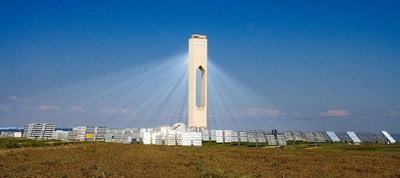
The Awesome Solar Tower of Seville

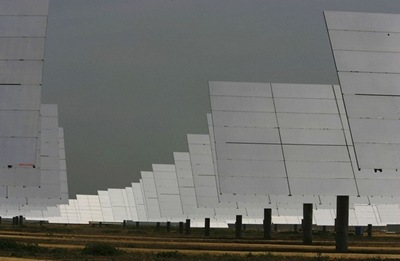
Located in the Andalusian countryside of Southern Spain, near Seville, is a giant 115 meter high concrete tower surrounded by a field of 624 huge mirrors. These mirrors collect the sunlight and focus it at the top of the concrete tower, where it heats water passing through pipes, converting it into steam. This steam drives a series of turbines that produce electricity. Simple, efficient, environment friendly and spectacular!

solar-tower (5)

solar-tower

solar-tower (2)

These 624 parabolic mirrors each having a surface area of 120m² are heliostats, that track the sun throughout the year, precisely focusing the sunlight to the top of the tower at all times. The temperature at the top rises to over 400'C (750'F).

solar-tower (1)

solar-tower (3)

solar-tower (4)

The current capacity of the Solar Tower is 11MW. The plant when completed in 2013, will produce around 300MW – energy enough for 180,000 homes, equivalent to the needs of the city of Seville, and saving 600,000 tonnes of annual carbon dioxide emissions. We urgently need more of these. - Original Source

5 Powerful Reasons To Invest Into Solar Panels and Save Money!

Save Money With Solar Panels

So 2008 is winding down and many things have happened this year. Recently the particle accelerator (Large Hadron Collider) was fired up and Barack Obama made young people everywhere have faith in politics.

But the real theme of 2008 has been gas prices. Many people everywhere are still wondering whether gas prices are going to get any cheaper. The reality is that, it will never get cheaper. That's right - never. Not only will gas never get cheaper, but everything we pay for that relies on petrochemicals for production - that is - everything you use - from your chair, computer, desk, plastics, vehicles - will never get cheaper.

Just think about that for a moment - everything that you rely on takes a source of energy that is quickly depleting. It takes many different refined sources of oil (petrochemicals) to manufacture pretty much all the goods and technology we enjoy in abundance. Some argue we have 20 years left, some argue we have 50 - the bottom line is there is a time line within most of our lifetimes.


Let's take a look at your home or apartment for a moment.

Depending on your location, your home is tied into a vast energy grid that is powered by things such as Hydroelectric dams to coal power plants. All of these take petrochemicals to maintain and construct as well.

My main point here is that, as a globe we need to begin changing our energy infrastructure while we have the oil to do it. Don't sweat though, the power is actually in your hands. So while we have this black gold available, we're still able to manufacture such things as solar panels to empower people to get off the grid.

Solar panels are pretty new, but have been around in theory for many many years. If you're a home owner, or even live in a small apartment - a solar panel can help you save money in the long run. But why should you invest besides reasons such as a lack of oil resources?

Here's 5 reasons why you should:

Reason #1 - Durability & Longevity

On average, a solar panel can last up to 30 years or more. With just a few arrays set up, you can be powering your home with your own renewable energy. Not only that, but solar panels are designed to withstand harsh climates. One common misconception is that you need the sun shining to convert to electricity. Solar panels can still convert from solar energy to electrical or thermal power even on a cloudy day (although not at the same capacity).

Reason #2 - Unlimited Power!

While everyone else is crying and whining about gas prices and high energy costs - you will have an unlimited supply of solar power. Unless the sun blows up and destroys our entire solar system - you won't really need to worry about never having power.

Reason #3 - Tax Incentives

Once you invest into solar, you are eligible for Federal, State, Provincial And Utility Tax incentives and rebates. These aren't the '$30 off' from your coffee maker rebates - they add up big time! For example, in Australia, if you spend $16,000 on a solar set up, they will rebate you up to $8000 back. This doesn't include other rebates you can get either. You'll need to check your own country's government policies - but, in the next 5-10 years - all countries will be jumping on the solar bandwagon.

Reason #4 - Not Just A 'One Time' Set Up + Easy Installation

With solar, you don't need to invest into a bunch of costly arrays right away. You're able to set up one panel at a time, and add additional panels whenever you feel the time is right. Furthermore, installing a solar panel is actually quite a lot easier than people think. You can do it yourself, or have an installer come and have it set up for you the same day.

Reason #5 - Add A 'Capacitor' And You Are Laughing + No More 'Blackouts'

A capacitor is a device that lets you store unused energy. So if you're over producing solar energy - usually two things happen. You can either give that energy back into the system grid (that is, pooling your energy into the grid for other people in your community to use) or you can store it in a capacitor. If you were ever to run out of energy, or you are seeing 'under production' - a capacitor lets you have energy that you stored previously. This means you will always have a back up of energy in a time of crisis.

What this also means (and having solar in general) is that when the system grid goes over its maximum energy potential (that is, too much energy is being used in the city which causes a blackout) - you will still be powered up! Your neighbors will be looking in jealousy at the one shiny house in the block.

So there you have it. If you're still not convinced - check out http://solar.envirohub.net for more information.