Showing posts with label Future of RET. Show all posts

Benefits of Renewable Energy

Renewable energy can supply a significant proportion of the United States' energy needs, creating many public benefits for the nation and for states and regions, including environmental improvement, increased fuel diversity and national security, and regional economic development benefits.

Environmental Benefits

Using fossil fuels -- coal, oil and natural gas -- to make electricity dirties the nation's air, consumes and pollutes water, hurts plants and animal life, creates toxic wastes, and causes global warming. Using nuclear fuels poses serious safety risks. Renewable energy resources can provide many immediate environmental benefits by avoiding these impacts and risks and can help conserve fossil resources for future generations. Of course, renewable energy also has environmental impacts. For example, biomass plants produce some emissions, and fuel can be harvested at unsustainable rates. Windfarms change the landscape, and some have harmed birds. Hydro projects, if their impacts are not mitigated, can greatly affect wildlife and ecosystems. However, these impacts -- which are discussed in Appendix A -- are generally much smaller and more localized than those of fossil and nuclear fuels. Care must nevertheless be taken to mitigate them.


Air Pollution

Clean air is essential to life and good health. Air pollution aggravates asthma, the number one children's health problem. Air pollution also causes disease and even premature death among vulnerable populations, including children, the elderly, and people with lung disease. A 1996 analysis by the Natural Resources Defense Council of studies by the American Cancer Society and Harvard Medical School suggests that small particles in the air may be responsible for as many as 64,000 deaths each year from heart and lung disease.[1] As the figure below shows, air pollution is responsible for more deaths than motor vehicle accidents, and ranks higher than many other serious health threats.[2] A few of the most important pollutants are discussed below.[3]

Numer of Deaths by Cause
Sulfur oxides

Sources of SOx Electricity production, primarily from burning coal, is the source of most emissions of sulfur oxides (SOx), as the figure shows. These chemicals are the main cause of acid rain, which can make lakes and rivers too acidic for plant and animal life. Acid rain also damages crops and buildings. National reductions in sulfur oxides required by the Clean Air Act Amendments of 1990 may not be sufficient to end damage from acid rain in the northeastern United States.[4] SO2 is also a primary source of fine particles in the air.


Nitrogen oxides

Sources of NOx Burning fossil fuels either to produce electricity or to power transportation emits nitrogen oxides (NOx) into the air. In the presence of sunlight, nitrogen oxides combine with other chemicals to form ground-level ozone (smog). Both nitrogen oxides and ozone can irritate the lungs, cause bronchitis and pneumonia, and decrease resistance to respiratory infections. In addition, research shows that ozone may be harmful even at levels allowed by federal air standards. The U.S. Environmental Protection Agency (EPA) has published a new rule reducing nitrogen oxide emissions from 0.12 parts per million to 0.08 parts per million. States have until 2003 to submit plans for meeting the new standard and up to 12 years to achieve it.[5]


Carbon dioxide

Sources of CO2 Carbon dioxide (CO2) is the most important of the greenhouse gases, which contribute to global warming by trapping heat in the earth's atmosphere. Electricity generation is, as the figure shows, the largest industrial source of carbon dioxide emissions and a close second to the transportation sector.

Samples from air bubbles trapped deep in ice from Antarctica show that carbon dioxide and global temperature have been closely linked for 160,000 years. Over the last 150 years, burning fossil fuels has resulted in the highest levels of carbon dioxide ever recorded. In 1995, the Intergovernmental Panel on Climate Change -- an authoritative international scientific body -- concluded that "the balance of evidence suggests that there is a discernible human influence on global climate."[6] All 10 of the warmest years on record have occurred in the last 15 years. The 1990s have already been warmer than the 1980s -- the warmest previous decade on record, according to the Goddard Institute of Space Studies.[7]

Atmospheric Carbon Dioxide Concentrations and Temperature Changes

Without action, carbon dioxide levels would double in the next 50 to 100 years, increasing global temperatures by 1.8 to 6.3 degrees Fahrenheit. The heat trapped in the atmosphere would cause expansion of the ocean's volume as surface water warms and melt some glaciers. A two-foot rise in sea level could flood 5,000 square miles of dry land in the United States, and another 5,000 square miles of coastal wetlands, as the figure shows. From 17 to 43 percent of coastal wetland-prime fish and bird habitat-could be lost. Building dikes and barriers could reduce flooding of dry land, but would increase wetland loss. Impacts on island nations and low-lying countries, like Egypt and Bangladesh, would be much worse.

US Coastal Lands at Risk from Sea Level Rise

Altered weather patterns from changes in climate may result in more extreme weather events. Some areas will suffer more drought and others more flooding, putting crop production under great stress in some regions. The character of our forests could change dramatically. Other expected impacts include an increase in heat-related deaths, increased loss of animal and plant species, and the spread of pests and diseases into new regions with less resistance to them.[8]

In 1997, at a conference in Kyoto, Japan, the developed nations of the world agreed to reduce carbon dioxide emissions. The United States agreed to 7 percent reductions from 1990 levels by the period 2008-2012. Senate ratification of this agreement remains uncertain, however.


Sun Power - the real power

SunPower, which makes solar cells and panels, says it has boosted the efficiency and size of its solar panels, yielding substantially more electricity than current panels.

The San Jose, Calif.-based company on Monday announced its second-generation, higher-power product at the Solar Power 2006 conference, and the panels are expected to be in mass production next year.

SunPower says it has managed to increase efficiency of the silicon cells from 20 percent to 22 percent. Further, the 5-foot by 3-and-a-half-foot panels will pack 96 individual cells within them, compared to the 72 contained in the company?s current product.

Overall, these changes result in a 43 percent increase in power, said Julie Blunden, vice president of external affairs at SunPower. Each panel can generate 315 watts of electricity and will have roughly the same cost per watt as the existing line, she said.

The theoretical limit of monocrystalline silicon cell efficiency is about 25 percent, Blunden said.

Other companies are developing solar photovoltaic manufacturing techniques around other materials, notably CIGS (copper indium gallium selenide).

But SunPower, which is owned by Cypress Semiconductor, intends to continue investing in higher solar efficiency and ways to lower the cost of installation, Blunden said.

Biofuels emissions may be 'worse than petrol'


Biofuels, once seen as a useful way of combating climate change, could actually increase greenhouse gas emissions, say two major new studies.

And it may take tens or hundreds of years to pay back the "carbon debt" accrued by growing biofuels in the first place, say researchers. The calculations join a growing list of studies questioning whether switching to biofuels really will help combat climate change.

Biofuel production has accelerated over the last 5 years, spurred in part by a US drive to produce corn-derived ethanol as an alternative to petrol.

See more

Benefits of Renewable Energy

Renewable energy provides many important benefits including:

  • Savings and Efficiency

  • Reliable Energy

  • Environmental benefits

  • Energy for the future

  • Jobs & the economy

  • Energy security

  • See more from here

The renewable energy future

Remember rain?

As Los Angeles creaks through its driest year on record and nervously awaits its next explosive wildfire, many wonder if global warming is already taking a toll. Nobody really knows; California has always had intermittent droughts, after all. But climate models predicted this situation. Changes in ocean temperatures and currents driven by things such as the melting of the Greenland ice shelf -- which is happening a lot faster than scientists expected -- will probably produce an even more desert-like climate in L.A.

See More

Future Power


Where on Earth can our energy-hungry society turn to replace oil, coal, and natural gas?

Freedom!

I stand in a cluttered room surrounded by the debris of electrical enthusiasm: wire peelings, snippets of copper, yellow connectors, insulated pliers. For me these are the tools of freedom. I have just installed a dozen solar panels on my roof, and they work. A meter shows that 1,285 watts of power are blasting straight from the sun into my system, charging my batteries, cooling my refrigerator, humming through my computer, liberating my life.
As National Geographic reported in June 2004, oil, no longer cheap, may soon decline. Instability where most oil is found, from the Persian Gulf to Nigeria to Venezuela, makes this lifeline fragile. Natural gas can be hard to transport and is prone to shortages. We won't run out of coal anytime soon, or the largely untapped deposits of tar sands and oil shale. But it's clear that the carbon dioxide spewed by coal and other fossil fuels is warming the planet, as this magazine reported last September.

See More

New York Sees Renewables Progress

The summary of a report on New York's Renewable Electricity Standard (RES) makes for some interesting reading. Some highlights:

  • Two solicitations for renewable energy have resulted in contracts for approximately 3 billion kilowatt hours (MWh) of renewable energy from 26 projects, totaling more than 800 megawatts (MW), or enough clean energy to supply approximately 400,000 average-size homes.

  • The New York State Energy Research and Development Authority (NYSERDA) estimates that more than $1.9 billion will be invested to build the New York-based renewable generation facilities awarded contracts under the RES. NYSERDA estimates that these investments have the potential to yield more than $720 million of in-state economic benefits over a 20-year period.

  • In addition to the significant economic benefits, the facilities awarded contracts under the RES could result in potential reductions of 2,000 tons of nitrogen oxides, 4,400 tons of sulfur oxides, and 1.3 million tons of carbon dioxide per year.

    NYSERDA is planning a third solicitation this fall, and says, "Considering the large number of wind projects under development, a significant number of potential bidders are expected, and consequently, reasonably priced bids are anticipated."

    What is happening in New York is a good example of what can happen with strong leadership at the state level. Former Gov. George Pataki (R) and current Gov. Elliott Spitzer (D) deserve enormous credit for pushing this effort forward.
  • Regards
    kkarthikeyan

    Converting wave energy into electricity

    Capturing wave energy and converting it into electricity is not an easy task, but researchers have developed technology to overcome the problems. Three of the pioneering devices are described here.

    TAPCHAN

    TAPCHAN is the name of a prototype generator that was installed on a remote Norwegian island in 1985 and has been functioning ever since. The name is an abbreviation of ‘tapered channel’, which describes the basic idea behind the device. TAPCHAN consists of a reservoir built into a cliff a few metres above sea level. Leading into it is a tapered channel – wide at the mouth, which is open to the sea, and becoming narrower as it penetrates the reservoir. Incoming waves increase in height as they move up the channel, eventually overflowing the lip of the channel and pouring into the reservoir. In this way, TAPCHAN converts the kinetic energy of the wave into potential energy, which is subsequently converted into electrical energy by a generator as the water is fed back to the sea through a pipe.

    Oscillating water column

    Another kind of wave energy converter is known as the oscillating water column (OWC). Like TAPCHAN, this is a fixed device – which means that the housing of the device does not move – located either onshore or fixed to the seabed. It consists of a wedge-shaped chamber that is open to the sea at the bottom. A wave surging into this chamber forces air upwards, which drives a turbine both on its way up (as the wave surges) and on its way down (as the wave recedes). These oscillations give the device its generic name. To take best advantage of this two-way flow, a special kind of turbine (such as the British-designed Wells turbine) is needed.

    An Australian scientist claims to have produced an innovative OWC design that greatly improves its performance. Dr Tom Denniss, from Energetech Australia, uses a parabolic wall (shaped like a satellite dish) to focus the energy of an incoming wave. The rushing air is used to drive a special turbine he claims is four to five times as efficient as the Wells turbine. A 200-300 kilowatt prototype is under development and will probably be installed at Wollongong or Newcastle, in New South Wales.

    The duck

    The ‘duck’ is an example of a floating wave energy converter. It is not fixed to the shore or seabed, relying instead on the ‘nodding’ motion of floats to drive a generator. In fixed devices, the turbine is fixed while the water or air rushes past its blades. Floating devices generate their power by the relative motion of components as they bob up and down in the sea. The duck consists of rows of floats, each generating electricity that is fed ashore by a connecting cable.

    One of the advantages of floating devices over fixed devices it that they can be deployed in deeper water, where wave energy is greater (since waves lose energy with decreasing water depth). There is no need for significant earthworks, either, as there is with onshore devices.

    Related site

    Wave power

    As any surfer knows, there’s plenty of energy in a wave. Waves are a form of solar energy – the uneven heating of the Earth by the sun causes air to move. This wind, in turn, transfers some of its energy to the surface layers of water bodies, particularly the ocean, thereby generating waves.

    Putting this energy to use has proved a titanic task for scientists. For example, sea water is highly corrosive, so making generators that are sensitive to small undulations in the sea yet strong enough to withstand the inevitable storms has been a major undertaking. But scientists are now confident that many of these difficulties are close to being solved. They have developed an array of potential machines, although few have been tested commercially (Box 1: Converting wave energy into electricity).

    The advocates of wave power foresee few environmental side-effects from a large-scale adoption of the technology. There is little potential for pollution – either chemical, visual or noise – and no greenhouse gas emissions. Floating devices are not expected to have any significant impact on the coastal environment, but they could present a hazard to shipping.

    Australia has a huge coastline and significant wave energy resources – particularly along the southern coast of the mainland and the west coast of Tasmania. But the potential for wave power to provide a significant amount of our energy needs remains untested

    Hot dry rocks – a form of geothermal energy

    ‘Geothermal’ means heat stored in rock. The best evidence of geothermal activity can be seen in regions close to the boundaries of tectonic plates – such as Japan and New Zealand – where hot springs, volcanoes and geysers are plentiful. These resources are already being used in some countries for heating and electricity generation.

    The words ‘Australia’ and ‘geothermal’ are not often closely associated. Australia doesn’t have any active volcanoes and relatively few hot springs or geysers. Yet, according to some Australian scientists, we have some of the best reserves of hot dry rocks in the world, offering prospects for a plentiful supply of energy.

    Australia’s hot dry rock resources are found in granite rock layers buried up to several kilometres underground, beneath layers of sedimentary rock. They are hot – up to 300ÂșC – because of what is known as the radiogenic decay of minerals, in which trace elements in the granite slowly break down, releasing heat as they do.

    Australian hot dry rock resources are unusually well suited to extraction because of a combination of three factors:

    • Heat is being generated in the crust at more than twice the global average.

    • The ‘blankets’ of sedimentary rock above the granite provide excellent insulation but are also of an optimal thickness for heat extraction.

    • The hot dry rocks are oriented horizontally, providing good (and relatively cheap) drilling access.

    The process of extracting the heat is quite simple. Water is pumped down into the hot granite through a bore-hole that may be several kilometres deep. This helps to open up existing tiny cracks in the granite, increasing the permeability of the rock. The water is converted to steam by the heat and is channelled to the surface through another bore-hole, where it can be used to drive a turbine and thereby generate electricity.

    Energy from hot dry rocks is not strictly renewable because the granite mass will eventually cool down. Nevertheless, it produces no greenhouse gases or other pollutants and has a very small ‘footprint’ on the landscape (unlike coal mining, hot dry rock energy requires no large-scale excavations). Some scientists say that Australia has enough hot dry rock resources – particularly in the Hunter Valley near Newcastle and the Eromanga Basin near the South Australia/Queensland border – to provide all our energy needs for centuries. A pilot project in the Hunter Valley is now underway.

    Renewable Energy

    Solar energy technologies, paired with energy conservation, have the potential to meet a large portion of future US energy needs...

    Renewable Energy for America's Future

    Energy for America's Future

    President George W. Bush delivers remarks to the Washington International Renewable Energy Conference 2008 Wednesday, March 5, 2008, at the Washington Convention Center in Washington, D.C. White House photo by Chris Greenberg

    President George W. Bush delivers remarks to the Washington International Renewable Energy Conference 2008 Wednesday, March 5, 2008, at the Washington Convention Center in Washington, D.C. White House photo by Chris Greenberg

    President Bush Attends Washington International Renewable Energy Conference 2008

    "...[L]et me start first by telling you that America has got to change its habits. We've got to get off oil. And the reason why is, first, oil is -- dependency on oil presents a real challenge to our economy. As economies grow -- and we want all our economies to grow; we want people to be prosperous, we want people who are living in poverty to be able to grow out of poverty. We want there to be general prosperity, but as economies grow, until we change our habits, there is going to be more dependency on oil."

    --President George W. Bush, March 5, 2008

    Spain: New Plan for Renewable Energy

    Spain's new energy law, passed earlier this summer, is designed to attract 23 billion Euro [approx. USD$27 billion] in investment by improving the legislative environment for renewable energy.

    The challenge is to make the renewable energy sector attractive to private investors, and to maintain and strengthen the interest that has been consolidated in some sectors, and extend it to others in which only timid steps have been taken so far.

    -- Plan de Energias Renovables

    The Energy Context in Spain

    One of the characteristics of the Spanish energy system is its high degree of dependence on imports. 80 percent of energy consumption has to be met from imported sources. Spain imports approximately 64 percent of the coal, 99.5 percent of the oil and 99.1 percent of the gas it uses. Moreover, oil accounts for around 50 percent of primary energy consumption.

    The strategies defined for the energy sector have been shaped by the international commitments of the European Union as a whole, and those of Spain in particular relating to energy supply and climate change. Promoting the use of energy from renewable sources plays a fundamental role in meeting both commitments.

    Clearly, as is necessarily the case, Spain's energy policy objectives coincide with those established by the European Union: a competitive and transparent liberalised market, security of supply, improved energy efficiency and protection of the environment.

    In Spain the development of renewable energy sources has been supported by various instruments over the last twenty-five years. A law promoting their use was first passed in 1980.

    On August 26, 2005 the Spanish government approved the new Renewable Energy Plan (Plan de Energias Renovables, PER), which supersedes the Renewable Energy Promotion Plan, which dates back to 1999. The overall aim of the new Plan is to make it possible to achieve the target of 12 percent of primary energy being met from renewable sources by 2010 and to do so it sets more ambitious objectives in those areas that have been developing successfully and establishes new measures to support technologies that have not yet managed to take off.

    The Renewable Energy Plan for 2005-2010 (PER)

    Renewable energy sources contribute to reducing energy dependence and increasing security of supply. Moreover, the development of renewable energy can make an active contribution to job creation, generally in less favored and sparsely populated areas. They can therefore contribute to rural development and stemming the rural exodus.

    The PER is an indicative Plan, meaning that it is not binding upon the actors in the energy system. However, it is hoped that slightly more than 97 percent of investments will come from the private sector. The aim is therefore to create a sufficiently attractive framework based on stability and profitability. The contribution of public funds to these investments is estimated to be just 2.9 percent.

    The Institute for Diversification and Saving of Energy (Instituto para la Diversificacion y Ahorro de la Energia, IDAE), a public state-owned body, has been entrusted with the task of preparing the PER. The methodology applied during the preparation of the Plan was aimed to ensure the participation of national government, the governments of Spain's autonomous regions, and academic and professional institutions.

    In each area an exhaustive analysis was conducted of state of the art technologies together with an evaluation of the requirements to overcome the main barriers to developing renewable energy sources in Spain. Concrete proposals for actions to overcome these barriers were then put forward. IDAE is also the body in charge of the monitoring of the PER.

    Forecasts in the PER

    In the most likely energy scenario the 2005-2010 Renewable Energy Plan targets will enable 12.1 percent of primary energy consumption to be met from renewable sources by 2010. Within this overall target, in 2010 electricity generation from renewable sources will account for 30.3 percent of gross consumption and liquid biofuels will account for 5.8 percent of petrol and diesel consumption for transport purposes.

    The table below gives detailed information on the current situation and the targets for 2010.

    TARGETS OF THE SPANISH RENEWABLE ENERGY PLAN FOR 2005-2010

    Situation in 2004 (average year (1)Target in 2010

    Capacity (MW)Energy (GWh)Energy (ktoe)Capacity (MW)Energy (GWh)Energy (ktoe)
    Electricity Generation


    Hydro-electric (>50MW) (3)13,52125,0141,97913,52125,0141,979
    Hydro-electric (10 MW to 50 MW)2,8975,7944983,2576,480557
    Hydro-electric (<10>1,7495,4214662,1996,692575
    Biomass3442,1936802,03914,0155,138
    Biomass power stations3442,1936801,3178,9803,586
    Co-combustion0007225,0361,552
    MSW1891,2233951891,223395
    Wind power8,15519,5711,68320,15545,5113,914
    Solar photovoltaic3756540060952
    Biogas1418252672351,417455
    Solar thermoelectric---5001,298509
    TOTAL ELECTRICITY GENERATION AREAS27,03360,0975,97342,494102,25913,574
    Thermal uses
    Biomass

    3,487

    4,070
    Low temperature solar thermal

    514,900,805
    376
    TOTAL THERMAL AREAS

    3,538

    4,446
    TOTAL BIOFUELS

    228

    2,200
    TOTAL RENEWABLE ENERGY SOURCES

    9,739

    20,220
    CONSUMPTION OF PRIMARY ENERGY (ktoe) (Energy scenario: Trend/PER)

    141,567

    167,100
    Energy from renewable sources/Primary energy (%)

    6.9%

    12.1%


    (1) Provisional 2004 data. For hydroelectric, wind, solar photovoltaic and solar thermal, the output for an average year has been taken, based on the power output and surface area in operation as of 31 December 2004, according to the characteristics of the installations brought into operation to date, and not the actual 2004 data. Thermal biogas and geothermal energy are not included. In 2004 these produced 28 and 8 ktoe, respectively [toe = tons of oil equivalent].

    Technology Targets

    As the table shows, a large share of the target is based on the contribution of wind power, which is forecast to reach 20,155 MW of installed capacity in 2010. The starting point is an installed capacity of 8,155 MW at the end of 2004.

    This figure has already placed Spain in second position worldwide, just behind Germany, and ahead of the United States. The development of wind power in Spain has been accompanied by the creation of companies that have developed their own technology and who compete successfully on international markets.

    By contrast, biomass, which is the other fundamental pillar to achieving the PER's targets, has not developed as fast as expected. The current Plan envisages new mechanisms to overcome the barriers to its development and, as a new feature, it includes the setting up of a co-combustion programme (for the joint combustion of biomass and coal in existing power stations).

    Regarding liquids biofuels for transport (LBT) the results achieved so far make it possible to be optimistic about achieving the objectives set for 2010. In the case of bioethanol Spain is the first producer in Europe.

    In solar energy, within a short space of time Spain has achieved a position of international leadership in photovoltaics, with three companies in the European top ten. By contrast, one of the challenges in the Plan is to overcome the barriers to the development of solar-thermal energy. Another important innovation envisaged in the Plan is the development of the first 500 MW solar-thermoelectric power stations in 2010.

    Alongside these energy targets it is hoped that other social and environmental goals will be achieved. In terms of employment over 1,300 companies are currently registered as being active in the sector. And in terms of the environment, the application of the Plan will avoid 27.3 million tons of CO2 emissions in 2010.

    Funding of the Plan

    Achieving the goals set implies a volume of investment estimated at approximately 23.6 billion Euros [approx. USD$27.7 billion]. Of this 97.1 percent is expected to come from private sources. Just 681 million Euros [approx. USD$799 million], 2.9 percent of the total, will be in the form of public investment aid.

    The challenge is therefore to make the renewable energy sector attractive to private investors, or rather, to maintain and strengthen the interest that has already been consolidated in some sectors, and extend it to others in which only timid steps have been taken so far.

    Of the approximately 22.9 billion Euros [approx. USD$26.9 billion] that it is hoped the private sector will attract, it is estimated that 4.7 billion Euros [approx. USD$5.5 billion] will come from direct contributions from developers and the remaining 18.2 billion Euros [approx. USD$21.4 billion], will come from bank loans provided through the usual financial mechanisms.

    In addition to the direct investment subsidies already mentioned, there are two other modes of public aid that are fundamental from the economic point of view. These are the premiums paid for electricity generated from renewable sources and the tax exemptions for LBT.

    The premiums for electricity generated from renewable sources are fundamental. This system has been used successfully to date and has created the favorable conditions for the spectacular growth of certain sectors, in particular wind power. The premium is a supplement to the price electricity producers can obtain on the market.

    The total value of the premiums related to the new generating facilities brought into operation over the period 2005-2010 is predicted to reach 4.9 billion Euros [approx. USD$5.8 billion]. From 2010 the annual premiums are forecast to be worth 1.8 billion Euros [approx. USD$2.1 billion]. It is worth stressing that although the figures are large in absolute terms, the impact on electricity prices of the premium policy is an increase of around 0.6 percent a year.

    The tax incentives for the use of LBT consist of an exemption from the tax on hydrocarbon fuels of the retail price. With this measure, the price of biofuels to the final consumer can be brought down to a level that allows them to compete with petroleum derivatives.

    About the Authors:
    Jose Gil and Hugo Lucas are in the International Relations Department of
    The Institute for Diversification and Saving of Energy (Instituto para la Diversificacion y Ahorro de la Energia, or IDAE), a public state-owned body based in Madrid, Spain.


    Spain is one of eight donor countries (excluding the European Union) to Renewable Energy and Energy Efficiency Program (REEEP). Austria, Germany, Italy, Ireland, the Netherlands, Spain, the United Kingdom, the United States and the European Union all contribute funds to the REEEP.


    RenewableEnergyAccess.com is seeking both domestic and international contributing newswriters to communicate news, trends, issues and policy on Renewable Energy from their home countries. Please follow this link to indicate your interest.

    cubic mile of oil (CMO)

    I just ran across an interesting article about renewable energy over at the Green Tech weblog. In it, they break down the type of investment that would be required to replace the energy provided by a cubic mile of oil (CMO).

    In case you’re not aware (as I wasn’t), a CMO is a measure of energy consumption. Apparently the world consumes slightly more than one CMO worth of energy from oil per year, and the equivalent of three CMOs from all energy sources. Over 80% of this total energy usage comes from fossil fuels, including oil, coal, and natural gas (see graph, below).

    So… What would it require to replace just one CMO of fossil energy per year?

    Solar panels

    Assuming annual electricity capture of 2.1 megawatts per solar panel, we’d have to place them on 4.2 billion rooftops. In other words, we’d have to install on them on 250,000 roofs per day for the next 50 years to have enough solar panels to offset our current annual oil usage (and this ignores things like coal; see below).

    Wind power

    What about wind power generators? You’d need 3 million to equal one CMO. That would require the installation of 1,200 per week for the next 50 years.

    Hydroelectric power

    A large hydroelectric dam can generate roughly 18 gigawatts of power per year. Thus, to offset one CMO of energy, we’d have to build 200 major hydroelectric dams. The problem? There aren’t enough rivers left in the world to dam up.

    Solar thermal power

    It would require 7,700 solar thermal plants to offset one CMO. That would require the construction of 150 plants per year for 50 years. Unfortunately, just one has been built in the past 15 years.

    Nuclear power plants

    It would take 2,500 nuclear power plants producing 900 megawatts to produce the equivalent of one CMO worth of energy. In other words, we’d have to build one a week for 50 years. It’s also worth noting that nuclear power isn’t exactly renewable.

    The future of demand

    Even if we decided to pursue one of the above options, it’s important to keep in mind that energy demand is continually increasing. According to Ripudaman Malhotra, a fossil fuels researcher at SRI International, world energy demand is expected to double to six CMOs within the next 30 years.

    The good news here is that we still have time. Current estimates show oil reserves of roughly 46 CMOs, natural gas reserves totalling 42 CMOs, and coal reserves of 121 CMOs. These numbers increase further when you add in difficult to extract sources such as tar sands.

    The bad news is that, beyond being non-renewable, these sources of energy also have a number of adverse environmental impacts, and burning more of them at a faster rate is just going to create more problems.

    The way forward

    Clearly, if we’re ever going to come anywhere near freeing ourselves from fossil fuels — an eventual necessity, as we’ll ultimately run out — it will require a tremendous investment, a variety of different technologies (likely including some that haven’t been invented yet), and an awful lot of conservation.

    Unfortunately, we’re dealing with a problem on such a massive scale that minor changes won’t be enough. Consider, for example, that replacing 1 billion incandescent bulbs with compact fluorescent bulbs only saves 0.01 CMOs per year. Yes, it’s important to cut back wherever we can. In this case, however, baby steps won’t be enough.

    It’s also important to keep in mind that all of the technologies listed above result in electricity production. Given that a large fraction of our energy consumption is currently non-electric, we’ll need a lot of other infrastructure changes to go along with this.

    Future of Renewable Energy

    Nanotechnology and the Future of Renewable Energy


    Nanotechnology operates at such a fundamental level that there is very little of a technological nature that it will not impact. Thus its effects on energy generation, transmission, storage and consumption are numerous and diverse. Some will be incremental and some quite possibly revolutionary.

    So, greenhouse nightmare or an emission-free future? Nanotechnology can enable them both. Barring a global wave of forward planning unseen in mankind's history, economics will probably make the decision for us.

    Rather than trying to sketch the whole landscape, a few examples will hopefully illustrate the variety.

    At the mundane end of the scale you have anti-fouling paints for wave or tidal power, or materials with a higher tolerance for radiation in nuclear reactors. I did say mundane.

    In wind power, the potentially enormous improvements in strength-to-weight ratio of composite materials used in blades could pay back surprisingly well because the relationship of blade length to efficiency is not linear but follows a power law -- though there is much argument about how this pans out in the real world.

    At the other extreme of nanotech impact, you have solar energy. We are children in this area, and the playground is built on the nanoscale. Almost any development is going to involve nanotech -- an intriguing recent exception being the use of lenses to focus light on old-fashioned silicon photovoltaics, thus demanding less of this expensive material.

    But what makes for a revolution in energy generation? Two things: availability and economics. The fact that solar energy is so bountiful -- enough hits the Earth in a minute to meet our global requirements for at least a week -- makes it potentially revolutionary; it's just the cost of capturing that energy that has been standing in the way. Reduce that enough, or increase the cost of the alternatives, and you have a winning scenario.

    One other energy source could, I believe, be equally revolutionary. Not fusion, which, despite the dreams of my youth, I sadly have to relegate to a distant future, not that the ongoing experiments aren't worthwhile. But geothermal energy, boring as hot rocks and steam may sound, has revolutionary potential for the same reason as solar -- an essentially unlimited supply of energy untapped only because of economics.

    The nanotech connection is not as direct here as with solar -- you have tougher materials to cut drilling costs or thermoelectric tunneling for efficient low-grade heat conversion -- but it only takes the right conjunction of developments and geothermal power stations will be springing up, or down, all over the place.

    I've only considered here principal power generation, but this should already give some sense of the breadth and potential scale of impact. I'd be surprised to find any reader of this unaware of the excitement surrounding developments in fuel cell and battery technology. Nanotechnology figures almost without exception in the cutting edge of both.

    So how do nanotechnology-based solutions apply to environmental concerns and energy security issues?

    From an energy security point of view, nanotech developments are invariably positive since, at the very least, they can help save energy -- aerogels for better insulation, IR-reflective window coatings, low-grade heat conversion in cars, etc. They also assist to varying degrees in the development of alternatives to the fossil fuels upon which so many of us are now so dangerously dependent. I've already mentioned the potential of solar and geothermal energy.

    On the environmental front the answer is not so clear. We live in a world where short-term economics have an overwhelming influence on decision making.

    The good news for those who worry about things like global warming, is that the increasing cost of oil -- a long-term trend that will not stop, oil being a finite resource -- and the decreasing cost of alternative sources such as solar energy, give renewables an ever more favorable economic position. When you look at the diverse spread of nanotech-related impacts they are almost always supporting technologies with an improved environmental profile.

    Unfortunately, there is a rather big exception to this. Nanotechnology has helped improve the effectiveness of catalysts. Fuel cells and catalytic converters are among the welcome beneficiaries.

    But catalysis is also at the heart of gas-to-liquid and coal liquefaction technologies that promise oil independence for those with access to previously uneconomical gas reserves or to coal reserves. Energy security is a big carrot and it so happens that two highly populated countries that rank among the fastest-growing economies in the world, and thus the fastest-growing energy consumers, are coal-rich: China and India. North America too is coal-rich.

    If such countries can start to economically run their cars, trucks and buses on diesel made from coal -- which ironically is low-emission compared with normal diesel at the vehicle end but overall produces more CO2 than oil-based diesel -- then we could be looking at a greenhouse gas nightmare scenario since there is enough coal in the world to supply our energy needs for hundreds of years.

    So, greenhouse nightmare or an emission-free future? Nanotechnology can enable them both. Barring a global wave of forward planning unseen in mankind's history, economics will probably make the decision for us.

    Making the Transition from Old to New Energy

    I think that the likeliest difference between "old" and "new" energy, and the generator of greatest debate, will be systemic rather than one particular technology or another. The question of when and how the transition to new energy occurs is also intriguing -- as the coal liquefaction scenario above shows, we could in theory be stuck with the old, or pretty similar, for some time to come.

    Only coal and nuclear fission are potential candidates for maintaining the uniform and monolithic energy network we have now in the developed world. There are good reasons to avoid both, if we can -- some would argue that we cannot.

    All the alternatives involve a mix of technologies and energy sources, with energy not always being produced where you want and when you want, thus producing a far more complex system than we have now. The phrase 'intelligent grid' is often held up as an example of how this complexity will operate, with buying, selling and saving of energy being possible at many scales.

    I'd rather do away with the 'grid' word altogether because it evokes the electricity grid that we in the developed world generally take for granted but which exists only as a consequence of our historical dependence on fossil fuels, and is grossly inefficient.

    In a mixed-energy-source scenario, the traditional grid would be challenged by localized generation, the form of which would vary according to location: Saudi, sunshine. Greenland, geothermal.

    The off-grid or localized grid scenario begs the question of how large amounts of energy will be transferred from one place to another, which will no doubt continue to be either required or an economically viable activity. The classic answer is hydrogen, but it is unfortunately a lousy way to transport energy, thanks largely to its volatility.

    In theory, the development of cheap, high-load superconducting cables -- perhaps made of carbon nanotubes -- might keep the old-fashioned grid alive but it seems to me that an efficient means of converting whatever energy source happens to be available to you into a fuel that is liquid, or close to it, at room temperature -- e.g., methanol -- combined with a fuel cell technology to make good use of it, would be a hard system to beat when it comes to storage and transmission.

    As I write, there are at least a few scientists around the world trying to figure out ways to outdo Mother Nature in turning sunlight into a compact, transportable energy source. All of which happens, of course, on the nanoscale.

    Ten facts about renewable energy

    As the impact of fossil fuels on our environment becomes ever more stark, renewable energy - with its non-polluting qualities and infinite capacity - is just what we need to save our fragile planet. It's thanks to the work of engineers and scientists that we are able to harness the renewable energy available to us and make it useful. Prepare yourself for our top 10 must-know renewable energy facts...

    1. There are five main forms of renewable energy: solar, wind, water, biofuel and geothermal (heat from the earth).

    2. If it could be properly harnessed, enough sunlight falls on the earth in just one hour to meet world energy demands for a whole year!

    3. Ever the innovator, Albert Einstein (left) won the Nobel Prize in Physics 1921 for his ground-breaking experiments with solar power and photovoltaics.

    4. The geothermal energy from the core of the Earth is closer to the surface in some areas than in others. Where hot underground steam or water can be tapped and brought to the surface it can be used to generate electricity.

    5. A world record was set in 1990 when a solar-powered aircraft flew across the USA in 21 stages, using no fuel at all.

    6. One wind turbine can produce enough electricity to power up to 300 homes.

    7. The largest wind turbine in the world, located in Hawaii, stands 20 storeys tall and has blades the length of a football pitch.

    8. An average wind speed of just 14mph is needed to convert wind energy into electricity; that shouldn't be too hard to come by in breezy Britain!

    9. Water is the most commonly used renewable energy resource, providing enough power to meet the needs of 28.3 million people.

    10. Those clever old Romans not only gave us the modern drainage system and many of our roads, they were also among the first to use geothermal energy to heat houses.

    SOLAR POWER

    During the day, there is a constant supply of radiation coming from the sun. The amount of radiation is considerable, but presently low cost commercial solid state solar cells only convert about 11% of the solar radiation into electricity. There are already laboratory solar cells that are 40% efficient, and in the future even higher efficiencies may be possible. Solid state solar cells are very attractive because they have no moving parts and are very simple. Because sunlight is free, this makes the technology very attractive especially in countries that have difficulty buying fuel. The downside of solid state solar cells is that when the sun goes down, there is no electricity being produced. Batteries can be used, but present batteries are only about 60-80% efficient in storing the electricity. Just as with wind turbines, if solar panels are linked into a large grid system, such fluctuations are not as much of a disadvantage.
    A second method of using the sun's radiation is to convert it into high temperature thermal energy and then use conventional steam turbines, gas turbines or Stirling engines to generate electricity. Such methods are already 30-50% efficient in converting the sun's radiation into electricity. There are also efficient solid state thermoelectric converters being researched. If a fluid is heated, a large amount can be stored for operation of the plant during the night or cloudy days. As well, a backup fuel fired heater can be used, but this is only economical when the power plant is highly efficient.
    A third desirable method is to use the sun's rays produce a fuel. This fuel could then be used at a later date. Hydrogen could be produced but it is difficult to store. An ideal fuel to produce would be ethanol or natural gas which could be used in a fuel cell at a later date to generate electricity or be used in other applications that require fuel. The solar cell would recycle the carbon dioxide from the atmosphere back into the ethanol or natural gas fuel. Such a solar cell might use genetically engineered bacteria to do the job.
    Theoretically much of the thermal energy required in society could come from solar energy. Practically so far it has been considered too intermittent a source. Solar collectors for this purpose can be quite simple, but storage of the thermal energy during periods when the sun isn’t shining has so far been considered expensive compared to cheap fossil fuel. This situation could dramatically change when fuel prices go up in the future.

    WIND POWER

    There is enough energy in the blowing winds to generate a substantial proportion of the electrical energy requirements in the world. In windy areas, the cost to produce electricity is already less than using fossil fueled combined cycle powerplants. One of the major problems with wind turbines in the past has been durability. Often serious wind storms would damage many units. Newer units appear to be built stronger. Another large problem is the extremely variable speed of the wind. Wind turbines may provide peak power in times when the electricity is not required. Storage of the electricity is expensive. If wind turbines are linked into a large grid system, such fluctuations are not as much of a disadvantage. Of course if a major proportion of our electricity would be generated this way, that would create major problems. Wind turbines in the past resulted in bird kills however it appears that with newer one’s this may not be a problem. Wind turbines are also noisy and can be unsightly. Still there are major advantages in tapping into a source of inexpensive power that can be converted into electricity in such a simple device as a wind turbine.

    MAJOR TECHNOLOGIES FOR PRODUCING POWER

    Electricity and mechanical power are largely used for powering our modern industrialized society. These are not stored in some natural form on earth in any great quantity. Other forms of energy must be converted. Different conversion technologies must be used. With some methods the electricity or mechanical power is produced directly in a single process. In others there are multiple steps involved.

    Hydro turbines ..convert moving water from river and ocean dams into electricity
    Wave generators ..use floats that move up and down with waves and produce electricity
    Solar cells ..solid state materials that produce electricity directly from solar radiation impact
    Thermocouples ..also called thermoelectric devices that produce electricity by heating dissimilar metals
    Thermionic devices ..turn thermal energy into electricity by solid state means
    Vapor turbines ..convert steam pressure into rotary motion then electricity
    Piston vapor engines ..convert vapor pressure into rotary motion then electricity
    Piston gas engines ..turn expanding gases to motion then electricity, Diesel, Otto, Brayton, Atkinson etc.
    Gas turbines ..turn hot expanding gases to rotary motion then electricity
    Stirling piston engines ..closed cycle engines turn thermal energy into motion then electricity
    MHD ..turn moving charged fluids directly to electricity
    Fuel cells ..turn chemical energy directly to electricity by the action of moving ions
    Wind turbines ..turn moving air into rotary motion then electricity
    Nuclear radiation cells ..solid state materials that produce electricity directly from nuclear radiation impact
    Nuclear "ion" cells ..solid state materials that produce electricity directly from nuclear "ions"

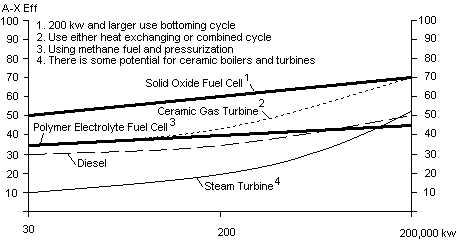
     Fig 1 Chart showing projected efficiencies of different future electricity generating powerplants

    Fig 1 Chart showing projected efficiencies of different future electricity generating powerplants

    Torpedo Solar Spotlight

    torpedo-sunlight.jpgWhat better way to lower your monthly electricity bill than rely on good ol’ solar power that never runs out (at least until our sun decides to explode)? The Torpedo Solar Spotlight makes a good candidate to spruce up your garden long after sundown at an affordable price.

    Make a walkway safer, uplight a tree or highlight garden art without the hassle of running extension cords or digging trenches for wiring. These garden spotlights are solar powered! Each 2¼” reflective lens has three bright LEDs that never need replacing, and an integrated solar panel that pivots and swivels to catch the best rays. Lights come on at dusk and shine for up to eight hours.