Great video.. Wow! I didn't know that burning fossil fuels produced pollution!
Showing posts with label Future of Solar Energy. Show all posts
Showing posts with label Future of Solar Energy. Show all posts
Our Future Energy - Solar
Capturing and Storing Energy From the Sun
Current interest in solar energy is not the first time people have been excited about its potential. Reportedly, the first flat-plate collector appeared in 1774. It consisted of a wooden box with three layers of glass that heated air to 140° F. By the turn of this century, development had progressed to the point that efficiencies were about as good as they are today.
Other sources of energy were more economical and convenient to use, so there was little incentive to put solar energy to work. But the finite supply of fossil fuels is now recognized, and we must prepare for the time when their cost may be much higher. An added benefit of solar energy would be reduced pollution, which will become more important as population increases.
The first consideration for any application is to reduce the energy requirement to the point where the economics of using solar collecting equipment is more favorable than investing in energy conservation measures. Most homes were constructed when fuel was plentiful and extremely cheap, so investment in solar heating and cooling should be thought about only after adequate weatherization.
The real cost of energy delivered from solar systems may range from the equivalent of $1 up to $10 per gallon of propane. At these levels, many energy conserving improvements will be economical. There is another payoff for weatherizing homes: they will be more comfortable because cold drafty conditions are reduced.
Equipment Can Prove Expensive
Energy from the sun is free, but equipment for collection, storage, and use can be expensive. A number of factors are involved in determining how much can be invested for a solar collecting system but the first cost of the equipment and the amount of energy that can be effectively used during its practical life are most important. The energy that can be used is determined by the solar energy available, ability of the collector to deliver energy, and whether that energy can be put to work or stored at the time it is collected.
An application such as water heating requires energy on a regular basis throughout most of the year, so more money can be invested in reliable, efficient hardware. Grain drying requires very large amounts of low-quality energy during a short period of time, so the system must be inexpensive or used for other applications during the rest of the year.
Investing in a solar collector depends to a great extent on tax credits granted by a State. With limitations, the Federal income tax credit of 25 percent plus the State tax credit in some States will now pay for up to 55 to 75 percent of the investment in solar equipment — which makes many solar systems economical.
Solar energy collecting systems often are classified as either active or passive. In active systems a fan or pump moves the working fluid or air through the collector. The fan or pump is turned on or off depending on whether the working fluid temperature is high enough to provide heat for storage or a process.
In passive systems the working fluid moves because of difference in density (hot air or hot water moves up and cold air or cold water moves down) or where the energy is moved by radiation or conduction heat transfer. Passive systems sometimes are defined as those where only a small amount of energy from fossil origin is used for moving the collected energy, for example one unit from fossil origin to 50 units derived from solar.
A system that combines both active and passive features is sometimes called a hybrid system and some authors classify this as a third type.
Photovoltaic collectors convert sunlight into direct current electrical energy but that method of energy collection is very expensive and used only for special purposes such as providing a small amount of energy for remote communications equipment and powering space vehicles. Therefore, this discussion is limited to applications where the function is to convert solar energy into heat energy.
Active Systems
Focusing collectors and flat-plate collectors are used for heating applications. Focusing collectors have a large area for entry of solar radiation that is then reflected onto a receiver. The entry area must be positioned so it sees the sun. This requires some type of mechanism to move the collector assembly during the day, which increases the cost of the collector.
High temperatures can be attained by focusing collectors. But most applications for heat in residences and farm service buildings can make use of energy gathered with flat-plate collectors.
Many different types of flat-plate collectors are being used or under development for putting solar energy to work in homes, farm service buildings, and agricultural processes. They range from simple systems costing very little to incorporate in the design of a new building, to more expensive equipment where cost is so high that the system would be economical only if conventional energy expenses increase.
Examples of inexpensive, simple systems are transparent roofs on farm service buildings for heating air to dry grain, or south-facing windows on residences that allow solar energy to be trapped inside. Complete systems for heating water may have an installed cost of $50 or more per square foot of collecting area.
Active systems are generally regarded as more complicated than passive systems, but a process such as grain drying can use a simple collector and maybe only one thermostat. Besides, passive systems can become complicated when controls and equipment are used to restrict natural air movement or when movable insulation is incorporated into the design. The prospective user should keep in mind that it is best to use as simple a system as possible that will provide heat for the user's needs.
Flat-plate collectors may be designed for operating only a few degrees above the outside temperature for uses such as grain drying. Those required to provide heat to a residence during winter may be designed for operating at a temperature differential of 100° F or more. Generally, cost of a flat-plate collector rises as the operating temperature differential increases.
The typical active system consists of a collector assembly, an energy storage unit, a control system, and two energy transport systems — one between the collector and storage and another between the storage and the process requiring heat.
Some vendors provide complete systems while others offer components that can be used to make up a complete system. Choosing between them depends on the type of process involved and abilities of the individual or contractor installing the system. Competent assistance should be found When planning a components system, because each component must be sized correctly to work with other parts of the system.
Backup System Needed
A backup heating system is needed because there are cloudy periods when solar energy cannot provide the necessary heat. The control system is quite important because it must be able to sense when heat can be added to storage, removed from storage, or when the backup furnace is required.
All these functions must work automatically because the typical user will not be present or may not be inclined to provide the manual controls needed to make the system work effectively.
The flat-plate collector for an active system consists of one or more of the following: 1) An absorber plate 2) A transparent cover or covers 3) Insulation behind the absorber plate 4) A box to contain the parts 5) An inlet and outlet to let the working fluid pass. The working fluid can be either liquid or air.
The bare-plate collector is used where low temperature differentials are adequate. Adding a transparent cover above the absorber allows a higher temperature to be maintained because heat loss from the absorber is reduced. A second transparent cover can be added to obtain even higher temperatures.
The absorber plate is generally made of sheet metal, or a flat surface of other material, and painted black to absorb the sun's rays. Flat black paint used for absorbers in high temperature collectors should be capable of operating at temperatures to 300° F, and possibly higher, without damage.
The absorber plate must serve to transfer absorbed solar heat to the working fluid. Fins protruding into the air may be added to the absorber, giving more surface area to transfer heat. With the liquid-type collector, the distance between liquid tubes determines how well heat can be transferred.
The weight of material in an absorber plate influences the time it takes to heat up before the working fluid can be circulated. Heavy plates require more time to heat up than light plates. During intermittent cloudiness, the plate might not heat up before a cloud cuts off solar energy. Then the heated plate would cool down while waiting for another period of sunshine.
Insulation Important
An exposed hot surface quickly loses heat, so the back side of the absorber must be insulated. Insulation between the absorber and the back of the collector box should be stable at high temperatures. Some insulations have organic materials in them that break down at high temperatures.
Vapor may deposit particulate matter on the inside of the transparent cover. This could make the collector useless until a new transparent cover is installed.
Features to reduce heat loss from the sides and ends of the collector should be incorporated into the box for the absorber plate. Collector boxes need to be sealed to exclude water, and strong enough to resist the loads imposed on them by wind and snow. Pipes or ducts entering or leaving the collector box should be insulated to reduce heat loss.
Glass has been commonly used as a transparent cover for collectors, but some plastics have desirable characteristics. Low-iron and plate glass are recommended because they absorb less solar energy than ordinary glass. The glass surface can be treated to reduce reflection, increasing transmitted energy.
Plastics are being used in many applications because construction of frames is not so critical and most plastics are somewhat less expensive than glass. Plastics resist impact stresses better than glass and generally transmit as much or more solar radiation. However, plastics generally allow more thermal energy loss than glass.
Care should be taken in selection to get plastic resistant to ultraviolet rays in sunlight and to the high temperatures encountered. The plastic should not retain a static charge which would attract dust.
Fans or pumps for moving the working fluid between the collector and storage need to be capable of long term, efficient operation. Ducts and pipes should be sealed and insulated; the amount of insulation recommended depends on the temperature difference between the working fluid and the surrounding air. Liquid leaks in pipes can be easy to spot, but air leaks in ducts present a problem because they aren't easily detected.
The control system needs to make decisions for operation of components and to be as simple as possible but still adequate to control all the aspects of operation. Where possible, users should understand the system so as to recognize when service is required or make their own adjustments and repairs.
Passive Systems
Passive solar systems are generally simple and low in cost for the quantity of heat added. Most are operated with a minimum of controls designed into the system, but may require manual adjustment.
Careful design may be required to obtain reasonably stable temperatures in the environmental space. Overheating or very cool conditions can result if the right combination of glazing and storage are not provided.
The four main types of passive solar systems are direct gain, thermal storage wall, attached sun space, and convective loop.
The direct gain system uses south-facing transparent walls, or windows, that allow solar radiation to enter directly into the environmental space that is to be heated. A part of the solar radiation is absorbed by the floor and a part reflected onto the walls and ceiling where it is absorbed.
The absorbed radiation is converted to thermal energy (heat). Some of it goes to heat up the storage material and some is lost by convection to the air which comes in contact with the floor and walls.
Movable insulation to reduce heat loss through the transparent cover at night increases overall thermal performance of this system.
The direct gain system is effective for south-facing surfaces because of the sun's low position in the sky during winter months. In summer when the sun is at a higher position in the sky, the glazed area can be shaded by overhang on the structure, awnings, or deciduous trees.
Advantages of the direct gain system are that it is one of the least expensive, simplest solar systems and can function without constructing a storage component in cases where the floor or wall can be used.
Disadvantages are degradation of fabrics and other materials in the room by ultraviolet radiation in the sunlight, temperature swings in the room which can be quite high unless thermal storage is carefully designed, the need for movable insulation to reduce heat loss through the glazing at night, and too much glare which can occur in the room during the day.
Thermal Siphon
The convective loop system has an absorbing surface placed behind the transparent cover on the south wall. This surface converts the sun's rays to heat energy that heats up the air and causes a thermal siphon effect. Cool air from the room flows up past the absorber where it is heated, and then exhausts near the ceiling. A small collector can be effective at heating a room during daytime, but there is limited storage and the room will cool off quickly at night.
Air movement caused by the thermosiphon would not be very effective at adding heat to massive walls inside the room. Thus one must be careful not to have too large a collector. At night, reverse thermal circulation can occur since the cold glass near the absorber cools it and will cause cool air to exist in the space between them which sets up a reverse circulation process. This should be prevented by closing off the loop at night.
Advantages of the convective loop system are that glare and ultraviolet degradation of fabrics are not problems, it is relatively inexpensive, it can be readily added to existing buildings, and night heat losses can be lower for other types of passive design. Disadvantages are that careful engineering and construction are required to insure proper airflow, prevent overheating, and assure adequate thermal isolation at night.
The thermal storage wall typically is a masonry wall with the south-facing side painted black to absorb solar radiation. The wall has one or two transparent covers. During the day, the south face of the wall is heated and starts the process of conducting heat through the wall. A so-called temperature wave moves through the concrete, causing the inside surface to be the wannest a few hours after sundown.
With thermal storage walls, glare and ultraviolet degradation of fabrics is not a problem, the temperature swing in adjacent living space is much lower, and designs are becoming available for allowing the proper sizing of units for homes. Disadvantages are the increased cost of constructing the wall, the space it occupies, and the amount of heat lost to the outside at night unless movable insulation is used.
Greenhouses, or similar structures called attached sunspaces, can be attached to new or existing buildings. The greenhouse is heated during the day and this warm air can be added to adjacent living space to reduce heat requirements.
A massive thermal storage wall can be used to absorb some of the solar radiation directly and transmit it to the adjacent living space and greenhouse during nighttime hours. The wall can reduce the amount of overheating that occurs in the greenhouse during daytime.
The sunspace acts as a buffer zone to reduce heat loss at night from the building to the outdoors. Advantages of the attached sunspace are that it provides smaller temperature swings in adjacent living space, reduces heat loss from adjacent living space to the outside, and is readily adaptable to existing buildings. Disadvantages are that thermal performance varies greatly from one design to another, making performance difficult to predict, and cost can be quite high if commercial buildings are used.
Storage Systems
Solar energy is received during the day and some type of storage system is required to allow that heat to be available at night. The two basic mechanisms for storing energy are to use sensible heat capacity of materials and to use the latent heat of fusion (heat given up during a change in phase from liquid to solid states).
Sensible heat capacity of a material is the amount of energy it takes to heat a unit of material. For example, it takes 1 British thermal unit (Btu) of energy to increase the temperature of 1 pound of water by 1° F. It takes about 5 pounds of rocks or concrete to store as much energy as 1 pound of water.
Even though water has the highest sensible heat storage capacity, rocks and concrete have advantages in applications such as air-type collectors and passive solar applications. Data in the table show the quantity of rocks or water required to store 500.000 Btu's of energy. This amount of energy would be equivalent to the heat produced by burning 7 to 8 gallons of propane.
| Thermal energy storage properties and requirements to store 500,000 Btu's with a 30° F change in temperature. | |||
| Rocks | Water | Phase-change material | |
| Specific heat capacity, Btu per lb per degree F | 0.2 | 1.0 | 0.5 (ave.) |
| Heat of fushion, Btu's per lb | - | - | 100 (ave.) |
| Density. lbs per cu ft | 90 | 62 | 100 |
| Storage of 500,000 Btu's | |||
| Weight, lbs | 88,500 | 16,670 | 4,350 |
| Volume, cu ft | 930 | 2701 | 552 |
| 12,000 gallons. | |||
| 2An additional 25% for passage of air is added to volume. | |||
Density of a material is the weight of that material that can be put in a box which is 1 foot in all three dimensions.
Multiplying the specific heat capacity by the density gives the volumetric heat capacity of a material. The volumetric heat capacity of water would be 62 while that for rocks would be 18 Btu's per cubic foot per degree Fahrenheit of temperature change. Thus water has a volumetric heat capacity over three times as great as for rocks.
Materials that change from liquid to solid at a temperature of around 90° F are being developed for the phase-change process, because large quantities of energy can be stored in a relatively small space. When water changes from liquid to solid (forms ice), 144 Btu's per pound of heat (the latent heat for fusion) are given up. Obviously, water cannot be used as a phase-change material in solar heating applications because 32° F is much too low to provide comfort.
Glauber's salt — sodium sulfate decahydrate — melts and freezes at 90° F and is one material being used for phase-change storages.
Considerable work is being done on these phase-change materials because large quantities of heat can be stored in a small space.
Phase-change material properties shown in the table are characteristic of those being used or considered for applications with solar systems. It takes four times the weight and five times the volume for water to store the same quantity of heat as this typical phase-change material. That has obvious advantages for retrofit applications because much less space is required to provide heat storage.
Rocks, Water Are Common Materials
Most energy storage systems that have been installed to date use the specific heat capacity of materials for storage. Rocks and water are both common materials and storage structures can be purchased or easily built.
An insulated steel tank is commonly used for liquid storage systems. Underground concrete tanks have been used for some larger systems, and fiber glass tanks for a number of smaller ones. Materials used to construct the tanks should be compatible with any chemical treatment the water requires.
Designs of a storage tank for water should allow for temperature stratification in the tank. This means hot water can be added to or removed from the top of the tank, and cold water can be added or removed from the bottom.
The void space between rocks in a storage allows passage of air. The rocks must be small enough so there is adequate surface area to allow heat transfer from the working fluid, air, to the rocks but large enough so the passageways allow easy movement of the working fluid. Rocks with an average diameter of 1 to 2 inches are usually recommended.
Rocks and packaged, phase-change materials are commonly used for air-type collectors. Packages for phase-change materials must be designed so there is adequate surface area for transfer of energy into or out of the unit.
All heat storage units — liquid, solid, or phase-change — must be insulated whether in the building, outside, or underground.
Reflectors
Reflecting surfaces can be positioned so they increase the amount of solar energy arriving at a collector. The correct position for a reflector depends on orientation of the collector and the season of the year during which it will be used. No general rule of thumb can be used to estimate the increase in collected energy because the changing position of the sun with the seasons affects the direction where solar energy is reflected.
The increase in collected solar energy per dollar invested in a reflector should be greater than from additional investment in collectors.
A computer simulation has been used to predict the increase in energy collected by a south-wall solar collector installed on a farrowing house in Kansas. A white-painted reflector in front of the collector and extending out as far as the collector is high (8 feet) increases collected solar energy by 15 to 16 percent. However, not all the reflected energy can be effectively used during spring and fall, so the net increase is only about 12 percent. Experimental testing has shown the computer simulation approximately correct for this Kansas location.
Information Sources
The prospective user should spend some time learning about solar energy technology. Another method is to enlist a good consultant, but the number of experienced technical personnel is limited and most are quite busy.
Sources for further study are textbooks and publications from State and Federal agencies, industrial associations, and companies selling components or complete systems. The National Solar Heating and Cooling Information Center, P.O. Box 1607, Rockville, MD 20850 provides a broad range of general information about solar energy.
Most State energy offices have personnel assigned to provide assistance on solar energy that is applicable to local conditions. They would be helpful in locating engineers and architects.
The Cooperative Extension Service provides publications and educational programs for agricultural applications. They will have plans available as they are developed.
Source: http://www.healthguidance.org/authors/488/Bob-BerglandNew Ways to Store Solar Energy for Nighttime and Cloudy Days

Solar power, the holy grail of renewable energy, has always faced the problem of how to store the energy captured from the sun’s rays so that demand for electricity can be met at night or whenever the sun is not shining.
The difficulty is that electricity is hard to store. Batteries are not up to efficiently storing energy on a large scale. A different approach being tried by the solar power industry could eliminate the problem.
The idea is to capture the sun’s heat. Heat, unlike electric current, is something that industry knows how to store cost-effectively. For example, a coffee thermos and a laptop computer’s battery store about the same amount of energy, said John S. O’Donnell, executive vice president of a company in the solar thermal business, Ausra. The thermos costs about $5 and the laptop battery $150, he said, and “that’s why solar thermal is going to be the dominant form.”
Solar thermal systems are built to gather heat from the sun, boil water into steam, spin a turbine and make power, as existing solar thermal power plants do — but not immediately. The heat would be stored for hours or even days, like water behind a dam.
A plant that could store its output could pick the time to sell the production based on expected price, as wheat farmers and cattle ranchers do. Ausra, of Palo Alto, Calif., is making components for plants to which thermal storage could be added, if the cost were justified by higher prices after sunset or for production that could be realistically promised even if the weather forecast was iffy. Ausra uses Fresnel lenses, which have a short focal length but focus light intensely, to heat miles of black-painted pipe with a fluid inside.
A competitor a step behind in signing contracts, but with major corporate backing, plans a slightly different technique in which adding storage seems almost trivial. It is a “power tower,” a little bit like a water tank on stilts surrounded by hundreds of mirrors that tilt on two axes, one to follow the sun across the sky in the course of the day and the other in the course of the year. In the tower and in a tank below are tens of thousands of gallons of molten salt that can be heated to very high temperatures and not reach high pressure.
“You take the energy the sun is putting into the earth that day, store it and capture it, put it into the reservoir, and use it on demand,” said Terry Murphy, president and chief executive of SolarReserve, a company backed in part by United Technologies, the Hartford conglomerate.
Power plants are typically designed with a heat production system matched to their electric generators. Mr. Murphy sees no reason why his should. His design is for a power tower that can supply 540 megawatts of heat. At the high temperatures it could achieve, that would produce 250 megawatts of electricity, enough to run a fair-size city.
It might make more sense to produce a smaller quantity and run well into the evening or around the clock or for several days when it is cloudy, he said.
At Black & Veatch, a builder of power plants, Larry Stoddard, the manager of renewable energy consulting, said that with a molten salt design, “your turbine is totally buffered from the vagaries of the sun.” By contrast, “if I’ve got a 50 megawatt photovoltaic plant, covering 300 acres or so, and a large cloud comes over, I lose 50 megawatts in something like 100 to 120 seconds,” he said, adding, “That strikes fear into the hearts of utility dispatchers.”
Thermal storage using molten salt can work in a system like Ausra’s, with miles of piping, but if the salt is spread out through a serpentine pipe, rather than held in a heavily insulated tank, it has to be kept warm at night so it does not solidify, among other complications.
A tower design could also allow for operation at higher latitudes or places with less sun. Designers could simply put in bigger fields of mirrors, proponents say. A small start-up, eSolar, is pursuing that design, backed by Google, which has announced a program to try to make renewable electricity for less than the price of coal-fired power.
Mr. Murphy helped build a power tower at a plant in Barstow, Calif., sponsored by the Energy Department in the late ’90s. It ran well, he said, but natural gas, a competing fuel, collapsed in price, and the state had few requirements for renewable power.
“There were not renewable portfolio standards,” Mr. Murphy said. “Nobody cared about global warming, and we weren’t killing people in Iraq.”
How to Store Solar Energy
If you’ve ever wondered how to store solar energy here are the basics. Solar energy is energy from the sun which is collected here on earth for heating, lighting and other human needs. Many of our basic energy needs can be addressed by using solar power. This can be done directly or indirectly but is not easy to do on a large scale. To store solar energy two components are required.
A means of collecting the solar energy and a way to generate it are needed to make sure we can access the sun’s energy. The collector collects the sun’s radiation and converts some of it to another form of energy such as electricity and heat. It is critical to find a way to store solar energy. This is because the sun does not shine for 24 hours a day and on overcast days the energy is inhibited.
The storage equipment is a way to accumulate excess energy when the sun’s rays are at maximum strength. When the sun is not shining or obscured this stored energy can be used. A backup supply also forms part of this system for times when the stored energy is insufficient. There are many ways to store solar energy. Three types of collectors are used to collect the sun’s radiation: 1) flat-plate collectors, 2) focusing collectors and 3) passive collectors.
Solar energy is very well suited for heating purposes. This heat energy can be stored in a liquid like water or a packed bed. A packed bed is a container in which small objects like stones can be placed. The stones are able to store solar energy. Heat energy can also be stored in phase-changer or heat-of-fusion units which use chemicals to alter solid to liquid at certain temperatures. Later the liquid can return to its solid form and the energy can be used.
This process is often used to store solar energy in homes to heat water. The water itself acts as the means to store solar energy. A tank is filled with hot water during the day and used when it’s required. Swimming pools can also be heated using solar energy. The water in the pool may act as a storage medium or a packed bed may be used instead. Solar energy can be used to heat homes. In this case a lot more energy is needed.
This means that larger solar panels need to be used to store solar energy. Heat-of-fusion storage units are usually used for this purpose but packed bed or hot water tanks are also sometimes used. It can be quite expensive to purchase large panels and a storage system to heat a large building. If a building is heated by solar power passive collectors are used with other storage systems.
One type of passive energy collector is the incidental heat trap. In this system heat enters through a window and falls on a stone floor. During the day the floor absorbs the heat and stays cool. At night the heat is released and heating is achieved. Another way to store solar energy is thermo-siphoning walls or roofs. In this system the heat that is absorbed and wasted in the walls and roof can be channeled for heating the home.
Solar Power: Advantages and Disadvantages
There are many advantages of solar energy. Just consider the advantages of solar energy over that of oil:
· Solar energy is a renewable resource. Although we cannot utilize the power of the sun at night or on stormy, cloudy days, etc., we can count on the sun being there the next day, ready to give us more energy and light. As long as we have the sun, we can have solar energy (and on the day that we no longer have the sun, you can believe that we will no longer have ourselves, either).
· Oil, on the other hand, is not renewable. Once it is gone, it is gone. Yes, we may find another source to tap, but that source may run out, as well.
· Solar cells are totally silent. They can extract energy from the sun without making a peep. Now imagine the noise that the giant machines used to drill for and pump oil make!
· Solar energy is non-polluting. Of all advantages of solar energy over that of oil, this is, perhaps, the most important. The burning of oil releases carbon dioxide and other greenhouse gases and carcinogens into the air.
· Solar cells require very little maintenance (they have no moving parts that will need to be fixed), and they last a long time.
· Although solar panels or solar lights, etc., may be expensive to buy at the onset, you can save money in the long run. After all, you do not have to pay for energy from the sun. On the other hand, all of us are aware of the rising cost of oil.
· Solar powered lights and other solar powered products are also very easy to install. You do not even need to worry about wires.
As you can see, there are many advantages of solar energy. The advantages of solar energy range from benefiting your pocketbook to benefiting the environment. There are actually only a few features of solar energy that can be considered disadvantages.
Here are the disadvantages of solar energy:
· Solar cells/panels, etc. can be very expensive.
· Solar power cannot be created at night.
As you can see the advantages of solar energy create a much longer list that the disadvantages, and the disadvantages are things that can be improved as technology improves.
Anne Clarke writes numerous articles for websites on gardening, parenting, the enviornment, fashion, and home decor. Her background includes teaching and gardening. For more of her articles on solar power, please visit Solar Home.
Advantages of solar energy
There are many advantages of solar energy. Just consider the advantages of solar energy over that of oil:
- Solar energy is a renewable resource. Although we cannot utilize the power of the sun at night or on stormy, cloudy days, etc., we can count on the sun being there the next day, ready to give us more energy and light. As long as we have the sun, we can have solar energy (and on the day that we no longer have the sun, you can believe that we will no longer have ourselves, either).
- Oil, on the other hand, is not renewable. Once it is gone, it is gone. Yes, we may find another source to tap, but that source may run out, as well.
- Solar cells are totally silent. They can extract energy from the sun without making a peep. Now imagine the noise that the giant machines used to drill for and pump oil make!
- Solar energy is non-polluting. Of all advantages of solar energy over that of oil, this is, perhaps, the most important. The burning of oil releases carbon dioxide and other greenhouse gases and carcinogens into the air.
- Solar cells require very little maintenance (they have no moving parts that will need to be fixed), and they last a long time.
- Although solar panels or solar lights, etc., may be expensive to buy at the onset, you can save money in the long run. After all, you do not have to pay for energy from the sun. On the other hand, all of us are aware of the rising cost of oil.
- Solar powered lights and other solar powered products are also very easy to install. You do not even need to worry about wires.
As you can see, there are many advantages of solar energy. The advantages of solar energy range from benefiting your pocketbook to benefiting the environment. There are actually only a few features of solar energy that can be considered disadvantages.
Here are the disadvantages of solar energy:
- Solar cells/panels, etc. can be very expensive.
- Solar power cannot be created at night.
As you can see the advantages of solar energy create a much longer list that the disadvantages, and the disadvantages are things that can be improved as technology improves.
Benefits of Purchasing Renewable Energy
According to the EIA, renewable energy, including hydropower and other renewables accounted for 8.8% of total U.S. energy generation in 2004. In recent years, however, there has been considerable growth in the use of renewable energy. Many state and local governments, for instance, have turned to renewable energy as a way to reduce local air pollution, reduce generation of greenhouse gases and/or stimulate the local economy. See below for more information.
Meet Greenhouse Gas Reduction Goals
In lieu of the ratification of the Kyoto Protocol by the United States, many public agencies and private businesses have voluntarily set greenhouse gas reduction goals. San Diego, for example, set a 15% GHG reduction goal in 2002 in partnership with the International Council for Local Environmental Initiatives (ICLEI). As of February 2006, 208 mayors have signed onto The US Mayors Climate Protection Agreement. These signatories have agreed to meet or exceed the Kyoto Protocol’s 7% GHG reduction goals (in comparison to 1990 levels) by 2012. For more information, go to the Pew Center on Global Change’s State and Local News page. Currently, 27 states have Climate Action Plans to reduce greenhouse gases1.
Industries and private businesses have taken initiative and partnered with the EPA Climate Leaders program to set emissions reduction goals and to monitor progress by reporting to the EPA.
Meet Air Quality Goals
Since 1990, the Federal Government, through the EPA, has set national ambient air quality standards (NAAQS) designed to regulate exposure to a list of harmful criteria pollutants. Many jurisdictions are classified as in “non attainment” and have not met these goals. Shifting to renewable energy may significantly reduce sulfur and nitrogen oxides, particularly in areas surrounding or downwind of energy production facilities. For a list of non attainment areas, visit http://www.epa.gov/air/oaqps/greenbk/
In 2004 Montgomery County included its wind purchase as an air pollution reduction strategy in the region's air quality plan, making it the first time the U.S. Environmental Protection Agency recognized wind power as a way of meeting federal air quality requirements2. For more information on this and other examples, see the EPA’s Green Power Partnership site.
Create Exportable Technology and Jobs
In the 1980’s, the US was a technological leader in solar and wind energy technology, but in the intervening years, other countries have taken the lead on many renewable technologies. A national commitment to renewable energy could allow the US to rapidly regain a position at the forefront3. Many believe that the development of domestic renewable resources could reinvigorate the local economy while helping the U.S. become more energy independent.
For example, a report published by faculty in the Energy and Resources Group and the Goldman School of Public Policy at the University of California Berkeley (Kammen et al. 2004 - http://ist-socrates.berkeley.edu/~rael/renewables.jobs.pdf ) that summarized 13 independent reports on job creation and renewable energy concluded that renewable energy generates more jobs than fossil-fuel energy for each unit of energy produced. Renewable energy operations have the potential to generate three to eleven times the number of jobs created by fossil-fuel operations, with solar and biomass exhibiting the highest potentials.
SunPower increasing solar cell capacity by 150 percent in 2008
In announcing financial results for the first quarter of 2008, SunPower Corporation stated that it would be increasing solar cell capacity by 150 percent in 2008, compared to capacity levels in 2007. The company also said that nearly half of its cell production was its ‘Gen2’ solar cell technology that has a minimum conversion efficiency of 22 percent.
“Our proprietary technology delivers the highest output per unit area of any commercially available solar system and we intend to leverage this technology by aggressively expanding our solar cell production by more than 150 percent in 2008 compared to 2007,” commented Tom Werner, SunPower's CEO, in a financial statement. “This scale, combined with lower silicon costs, higher efficiencies, thinner wafers and on-going quality and cost improvements in our factories, will drive unit cost reduction. During the first quarter of 2008, we continued to meet or exceed our manufacturing targets across both of our fabs and our panel manufacturing facility.”
The company also noted that it has secured 100 percent of its required polysilicon supply through 2010 to meet its revised capacity expansion plans. Last year, SunPower projected that production would top 250MW in 2008. However, revised figures revealed by the company show that figure to be 255MW for 2008.
The same is true for 2009. SunPower previously stated that it would produce 430MW in 2009; that figure has been raised to 450MW-plus. For 2010, the company is still expecting production of 650MW-plus, but has not adjusted the baseline figure upwards.
SunPower also reiterated that its capacity ramp at Fab 2 remained on schedule and was expected to be completed by the end of 2009. Its fourth solar panel manufacturing line had also completed its production ramp allowing the company to produce more than half of its PV panels in-house.

Sun Power - the real power
SunPower, which makes solar cells and panels, says it has boosted the efficiency and size of its solar panels, yielding substantially more electricity than current panels.
The San Jose, Calif.-based company on Monday announced its second-generation, higher-power product at the Solar Power 2006 conference, and the panels are expected to be in mass production next year.
SunPower says it has managed to increase efficiency of the silicon cells from 20 percent to 22 percent. Further, the 5-foot by 3-and-a-half-foot panels will pack 96 individual cells within them, compared to the 72 contained in the company?s current product.
Overall, these changes result in a 43 percent increase in power, said Julie Blunden, vice president of external affairs at SunPower. Each panel can generate 315 watts of electricity and will have roughly the same cost per watt as the existing line, she said.
The theoretical limit of monocrystalline silicon cell efficiency is about 25 percent, Blunden said.
Other companies are developing solar photovoltaic manufacturing techniques around other materials, notably CIGS (copper indium gallium selenide).
But SunPower, which is owned by Cypress Semiconductor, intends to continue investing in higher solar efficiency and ways to lower the cost of installation, Blunden said.
Sunlight Solar Energy
Sunlight Solar Energy, Inc. is one of the leading photovoltaic design and installation corporations in the US and is an approved contractor under energy fund photovoltaic programs in 5 states.
SSE quotes you a complete "turnkey" solar photovoltaic installation, including all necessary paperwork, permits and contracts. Sunlight Solar Energy, Inc. is a premier dealer of SunPower.
SunPower panels and inverters are high performance and intelligent design.
Read more...
Generating Power from Solar Energy
How Sunlight is Converted to Electricity Using Photovoltaic Process
Solar power is electricity that is generated from sunlight, and is a common choice of renewable energy for households and for large companies. There are two basic forms of solar power in current use: photovoltaics and solar thermal power.Photovoltaic Solar Power
Photovoltaic systems, such as conventional solar panels, directly convert sunlight into energy using the principles of the photovoltaic effect. The photovoltaic effect takes advantage of the properties of semiconductor materials, with silicon being the primary material used in photovoltaic solar cells. When photons strike the solar cell, electrons in the semiconductor material are shaken loose, allowing them to flow as electricity. This electricity is direct current (DC), and can be directly used to charge batteries, or can be connected to an inverter to power alternating current (AC) components, or to be connected to the local electrical grid.
Traditional photovoltaic systems are based on silicon. Silicon ingots are sliced into wafers that are fabricated into cells. Cells are combined into modules, which are packaged into end-user systems. Silicon-based solar cells have efficiencies of approximately 14-19%. However, newer systems that use gallium arsenide, another semiconductor material, can be made into thinner and more flexible modules. These "thin film" modules can presently produce efficiencies up to 30%, but currently cost more to fabricate than traditional silicon-based modules.
Benefits of Renewable Energy
Renewable energy provides many important benefits including:
-
Savings and Efficiency
-
Reliable Energy
-
Environmental benefits
-
Energy for the future
-
Jobs & the economy
-
Energy security
- See more from here
Storing Solar Power Efficiently

Thermal-power plants that store heat for cloudy days could solve some of the problems with solar power.
Solar proponents love to boast that just a few hundred square kilometers' worth of photovoltaic solar panels installed in Southwestern deserts could power the United States. Their schemes come with a caveat, of course: without backup power plants or expensive investments in giant batteries, flywheels, or other energy-storage systems, this solar-power supply would fluctuate wildly with each passing cloud (not to mention with the sun's daily rise and fall and seasonal ebbs and flows). Solar-power startup Ausra, based in Palo Alto, thinks it has the solution: solar-thermal-power plants that turn sunlight into steam and efficiently store heat for cloudy days.
"Fossil-fuel proponents often say that solar can't do the job, that solar can't run at night, solar can't run the economy," says David Mills, Ausra's founder and chairman. "That's true if you don't have storage." He says that solar-thermal plants are the solution because storing heat is much easier than storing electricity. Mills estimates that, thanks to that advantage, solar-thermal plants capable of storing 16 hours' worth of heat could provide more than 90 percent of current U.S. power demand at prices competitive with coal and natural gas. "There's almost no limit to how much you can put into the grid," he says.
Major utilities are buying the idea. In July, the Pacific Gas and Electric Company (PG&E) signed a 25-year deal with Ausra competitor Solel Solar Systems of Beit Shemesh, Israel, to buy power from a 553-megawatt solar-thermal plant that Solel is developing in California's Mojave Desert. The plant will supply 400,000 homes in northern and central California when it is completed in 2011. Florida Power & Light, meanwhile, hired Solel to upgrade the 1980s-era solar-thermal plants it operates in the Mojave.
Ausra, meanwhile, is negotiating with PG&E to supply power from a 175-megawatt plant that it plans to build in California, for which it secured $40 million in venture financing this month.
What distinguishes Ausra's design is its relative simplicity. In conventional solar-thermal plants such as Solel's, a long trough of parabolic mirrors focuses sunlight on a tube filled with a heat-transfer fluid, often some sort of oil or brine. The fluid, in turn, produces steam to drive a turbine and produce electricity. Ausra's solar collectors employ mass-produced and thus cheaper flat mirrors, and they focus light onto tubes filled with water, thus directly producing steam. Ausra's collectors produce less power, but that power costs less to produce.
One megawatt's worth of Ausra's solar collectors has been producing steam in New South Wales, Australia, since 2004; the steam is fed into the turbines of a primarily coal-fired power plant. The final piece of the system--a proprietary heat-energy-storage system--should be ready by 2009.
SOLAR ENERGY AS CHEAP AS COAL!

Energy company Sunrgi recently announced an astounding new solar system that will break our grids free from the fossil fuel lockdown. Their Xtreme Concentrated Photovoltaics promise a low-cost, high-efficiency system with an incredible projected energy pricing of 5 cents per kilowatt. This breakthrough puts solar on par with the cost of coal, natural gas, and other non-renewable energy sources.
If solar energy is ever going to live up to it’s world-changing potential, it’s going to have to mesh with our existing energy infrastructure, competing with coal and natural gas on price point. While traditional photovoltaic arrays span great expanses and struggle to keep costs down, Sunrgi’s system proposes a novel idea, making better use of fewer expensive materials.
The XCPV system is based on a principle blinding in its simplicity: use a magnifying glass to concentrate the sun’s energy into a single high efficiency solar cell. Each unit features a lens that magnifies the sun’s rays 2,000 times, focusing it onto a solar cell that converts more than 37% sunlight to energy. The result is a system that maximizes the potential output of each solar cell while minimizing cost and space required.

The units are modular and thus easily deployable on or off-grid, and they can be easily upgraded to accommodate future advancements in solar cell technology. To deal with the tremendous temperature of focused sunlight (more than 3,000 ºF!), Sunrgi has developed a proprietary cooling system that keeps the panels safe and sound. Rounding out the tech is a sun-tracking system and a PV cell composition that doesn’t depend on the world’s depleted silicon reserves.
Craig Goodman, president of the National Energy marketers Association, has stated that “Solar power at 5 cents per kWh would be a world-changing breakthrough. It would make solar generation of electricity as affordable as generation from coal, natural gas, or other non-renewable sources, without require and subsidy.”
Sunrgi has built and tested working prototypes, and has announced plans for commercial production in 12-15 months.

Renewable energy plan unveiled for 2006-2010
BEIJING -- China's annual consumption of renewable energy will reach the equivalent of 300 million tons of standard coal by 2010, which would be 10 percent of its total annual energy consumption, under the renewable energy development plan for 2006-2010.
The plan was released on Tuesday by the National Development and Reform Commission (NDRC), the country's top economic planning agency.
The plan says 2010 renewable energy consumption will nearly double the 2005 level, which was equivalent to 166 million tons of standard coal. That led to a reduction of 3 million tons of sulfur dioxide emissions and more than 400 million tons of carbon dioxide emissions.
Given the dearth of petroleum and natural gas resources and the large share of coal in China's energy production, it is difficult for the nation to sustain its development and protect the environment by relying simply on fossil fuels, the NDRC said.
China boasts abundant renewable resources that could be exploited, the plan says. It says that by 2010:
-- the nation will have hydropower projects with a combined installed capacity of 190 million kilowatts and wind power projects with installed capacity of 10 million kw.
-- the installed capacity of bio-energy projects will reach 5.5 million kw and that of solar energy projects will be 300,000 kw.
-- domestically produced hydropower equipment and solar water heaters should become competitive on global markets.
-- wind power equipment manufacturers should put generating units with installed capacities of at least 1.5 million watts into mass production.
SOLAR POWER
During the day, there is a constant supply of radiation coming from the sun. The amount of radiation is considerable, but presently low cost commercial solid state solar cells only convert about 11% of the solar radiation into electricity. There are already laboratory solar cells that are 40% efficient, and in the future even higher efficiencies may be possible. Solid state solar cells are very attractive because they have no moving parts and are very simple. Because sunlight is free, this makes the technology very attractive especially in countries that have difficulty buying fuel. The downside of solid state solar cells is that when the sun goes down, there is no electricity being produced. Batteries can be used, but present batteries are only about 60-80% efficient in storing the electricity. Just as with wind turbines, if solar panels are linked into a large grid system, such fluctuations are not as much of a disadvantage.
A second method of using the sun's radiation is to convert it into high temperature thermal energy and then use conventional steam turbines, gas turbines or Stirling engines to generate electricity. Such methods are already 30-50% efficient in converting the sun's radiation into electricity. There are also efficient solid state thermoelectric converters being researched. If a fluid is heated, a large amount can be stored for operation of the plant during the night or cloudy days. As well, a backup fuel fired heater can be used, but this is only economical when the power plant is highly efficient.
A third desirable method is to use the sun's rays produce a fuel. This fuel could then be used at a later date. Hydrogen could be produced but it is difficult to store. An ideal fuel to produce would be ethanol or natural gas which could be used in a fuel cell at a later date to generate electricity or be used in other applications that require fuel. The solar cell would recycle the carbon dioxide from the atmosphere back into the ethanol or natural gas fuel. Such a solar cell might use genetically engineered bacteria to do the job.
Theoretically much of the thermal energy required in society could come from solar energy. Practically so far it has been considered too intermittent a source. Solar collectors for this purpose can be quite simple, but storage of the thermal energy during periods when the sun isn’t shining has so far been considered expensive compared to cheap fossil fuel. This situation could dramatically change when fuel prices go up in the future.
WIND POWER
There is enough energy in the blowing winds to generate a substantial proportion of the electrical energy requirements in the world. In windy areas, the cost to produce electricity is already less than using fossil fueled combined cycle powerplants. One of the major problems with wind turbines in the past has been durability. Often serious wind storms would damage many units. Newer units appear to be built stronger. Another large problem is the extremely variable speed of the wind. Wind turbines may provide peak power in times when the electricity is not required. Storage of the electricity is expensive. If wind turbines are linked into a large grid system, such fluctuations are not as much of a disadvantage. Of course if a major proportion of our electricity would be generated this way, that would create major problems. Wind turbines in the past resulted in bird kills however it appears that with newer one’s this may not be a problem. Wind turbines are also noisy and can be unsightly. Still there are major advantages in tapping into a source of inexpensive power that can be converted into electricity in such a simple device as a wind turbine.
MAJOR TECHNOLOGIES FOR PRODUCING POWER
Electricity and mechanical power are largely used for powering our modern industrialized society. These are not stored in some natural form on earth in any great quantity. Other forms of energy must be converted. Different conversion technologies must be used. With some methods the electricity or mechanical power is produced directly in a single process. In others there are multiple steps involved.
Hydro turbines ..convert moving water from river and ocean dams into electricity
Wave generators ..use floats that move up and down with waves and produce electricity
Solar cells ..solid state materials that produce electricity directly from solar radiation impact
Thermocouples ..also called thermoelectric devices that produce electricity by heating dissimilar metals
Thermionic devices ..turn thermal energy into electricity by solid state means
Vapor turbines ..convert steam pressure into rotary motion then electricity
Piston vapor engines ..convert vapor pressure into rotary motion then electricity
Piston gas engines ..turn expanding gases to motion then electricity, Diesel, Otto, Brayton, Atkinson etc.
Gas turbines ..turn hot expanding gases to rotary motion then electricity
Stirling piston engines ..closed cycle engines turn thermal energy into motion then electricity
MHD ..turn moving charged fluids directly to electricity
Fuel cells ..turn chemical energy directly to electricity by the action of moving ions
Wind turbines ..turn moving air into rotary motion then electricity
Nuclear radiation cells ..solid state materials that produce electricity directly from nuclear radiation impact
Nuclear "ion" cells ..solid state materials that produce electricity directly from nuclear "ions"
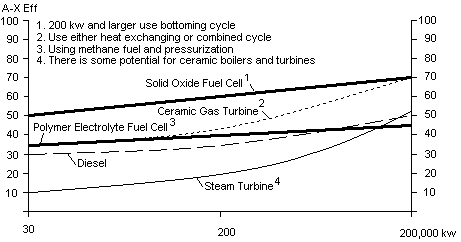
Fig 1 Chart showing projected efficiencies of different future electricity generating powerplants
Torpedo Solar Spotlight
 What better way to lower your monthly electricity bill than rely on good ol’ solar power that never runs out (at least until our sun decides to explode)? The Torpedo Solar Spotlight makes a good candidate to spruce up your garden long after sundown at an affordable price.
Make a walkway safer, uplight a tree or highlight garden art without the hassle of running extension cords or digging trenches for wiring. These garden spotlights are solar powered! Each 2¼” reflective lens has three bright LEDs that never need replacing, and an integrated solar panel that pivots and swivels to catch the best rays. Lights come on at dusk and shine for up to eight hours.
Subscribe to:
Posts (Atom)


 Posts


