The Best Wind Energy Companies

The Wind Energy Industry

First, let’s get a quick rundown of the growth of the domestic and international wind markets out of the way.

Here’s the chart for wind power capacity growth by year:

wind power capacity growth by country

As you can see, global installed capacity for wind energy has grown 482% over the last seven years, from 14,604 MW in 2000 to 84,934 MW in 2007.

Broken down further, the international wind industry has a compounded annual growth rate (CAGR or year-over-year) of 28.6%, which is impressive, to say the least.

But the past performance of the wind energy stocks is going to do little to help the future performance of your portfolio, apart from establishing an historic trend and highlighting what you’ve been missing.

So here’s the global wind energy installed capacity forecast, going out to 2012:

wind energy installed capacity forecast
This data reveals that the industry will grow 215% between 2007 and 2012, from 84,934 MW to 267,837 MW. That’s a CAGR of 25.8%

Now this is information that can give your portfolio a boost. In an industry that’s doubling in size every four years or less, there are surely more than a few companies worthy of investment operating within it.

The only thing left to do is to actively seek out the best ones.

To start the search, it’s probably worth taking a look at the countries currently boasting the highest year-over-year growth in the wind industry. So here they are, along with their respective annual growth rates, as provided by GlobalData:

  • Turkey, 95.4%
  • Mexico, 84.7%
  • Brazil, 61%
  • China, 54%
  • Poland, 50.9%

Of course, those are the fastest growing markets. According to GlobalData, the largest markets by megawatt capacity are:

  • China, 51,200 MW
  • U.S, 45,454 MW
  • Spain, 36,715 MW
  • Germany, 35,829 MW
  • India, 25,935 MW

The only thing left to do is single out the largest operators in those areas, invest, and reap the profits.

Read More From here

Solar Power Wins Enthusiasts but Not Money

The trade association for the nuclear power industry recently asked 1,000 Americans what energy source they thought would be used most for generating electricity in 15 years. The top choice? Not nuclear plants, or coal or natural gas. The winner was the sun, cited by 27 percent of those polled.

It is no wonder solar power has captured the public imagination. Panels that convert sunlight to electricity are winning supporters around the world — from Europe, where gleaming arrays cloak skyscrapers and farmers’ fields, to Wall Street, where stock offerings for panel makers have had a great ride, to California, where Gov. Arnold Schwarzenegger’s “Million Solar Roofs” initiative is promoted as building a homegrown industry and fighting global warming.

But for all the enthusiasm about harvesting sunlight, some of the most ardent experts and investors say that moving this energy source from niche to mainstream — last year it provided less than 0.01 percent of the country’s electricity supply — is unlikely without significant technological breakthroughs. And given the current scale of research in private and government laboratories, that is not expected to happen anytime soon.


Read More

The Awesome Solar Tower of Seville

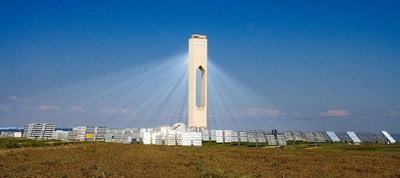
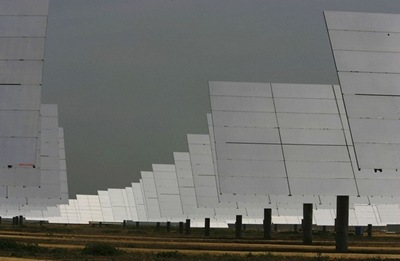
Located in the Andalusian countryside of Southern Spain, near Seville, is a giant 115 meter high concrete tower surrounded by a field of 624 huge mirrors. These mirrors collect the sunlight and focus it at the top of the concrete tower, where it heats water passing through pipes, converting it into steam. This steam drives a series of turbines that produce electricity. Simple, efficient, environment friendly and spectacular!

solar-tower (5)

solar-tower

solar-tower (2)

These 624 parabolic mirrors each having a surface area of 120m² are heliostats, that track the sun throughout the year, precisely focusing the sunlight to the top of the tower at all times. The temperature at the top rises to over 400'C (750'F).

solar-tower (1)

solar-tower (3)

solar-tower (4)

The current capacity of the Solar Tower is 11MW. The plant when completed in 2013, will produce around 300MW – energy enough for 180,000 homes, equivalent to the needs of the city of Seville, and saving 600,000 tonnes of annual carbon dioxide emissions. We urgently need more of these. - Original Source

5 Powerful Reasons To Invest Into Solar Panels and Save Money!

Save Money With Solar Panels

So 2008 is winding down and many things have happened this year. Recently the particle accelerator (Large Hadron Collider) was fired up and Barack Obama made young people everywhere have faith in politics.

But the real theme of 2008 has been gas prices. Many people everywhere are still wondering whether gas prices are going to get any cheaper. The reality is that, it will never get cheaper. That's right - never. Not only will gas never get cheaper, but everything we pay for that relies on petrochemicals for production - that is - everything you use - from your chair, computer, desk, plastics, vehicles - will never get cheaper.

Just think about that for a moment - everything that you rely on takes a source of energy that is quickly depleting. It takes many different refined sources of oil (petrochemicals) to manufacture pretty much all the goods and technology we enjoy in abundance. Some argue we have 20 years left, some argue we have 50 - the bottom line is there is a time line within most of our lifetimes.


Let's take a look at your home or apartment for a moment.

Depending on your location, your home is tied into a vast energy grid that is powered by things such as Hydroelectric dams to coal power plants. All of these take petrochemicals to maintain and construct as well.

My main point here is that, as a globe we need to begin changing our energy infrastructure while we have the oil to do it. Don't sweat though, the power is actually in your hands. So while we have this black gold available, we're still able to manufacture such things as solar panels to empower people to get off the grid.

Solar panels are pretty new, but have been around in theory for many many years. If you're a home owner, or even live in a small apartment - a solar panel can help you save money in the long run. But why should you invest besides reasons such as a lack of oil resources?

Here's 5 reasons why you should:

Reason #1 - Durability & Longevity

On average, a solar panel can last up to 30 years or more. With just a few arrays set up, you can be powering your home with your own renewable energy. Not only that, but solar panels are designed to withstand harsh climates. One common misconception is that you need the sun shining to convert to electricity. Solar panels can still convert from solar energy to electrical or thermal power even on a cloudy day (although not at the same capacity).

Reason #2 - Unlimited Power!

While everyone else is crying and whining about gas prices and high energy costs - you will have an unlimited supply of solar power. Unless the sun blows up and destroys our entire solar system - you won't really need to worry about never having power.

Reason #3 - Tax Incentives

Once you invest into solar, you are eligible for Federal, State, Provincial And Utility Tax incentives and rebates. These aren't the '$30 off' from your coffee maker rebates - they add up big time! For example, in Australia, if you spend $16,000 on a solar set up, they will rebate you up to $8000 back. This doesn't include other rebates you can get either. You'll need to check your own country's government policies - but, in the next 5-10 years - all countries will be jumping on the solar bandwagon.

Reason #4 - Not Just A 'One Time' Set Up + Easy Installation

With solar, you don't need to invest into a bunch of costly arrays right away. You're able to set up one panel at a time, and add additional panels whenever you feel the time is right. Furthermore, installing a solar panel is actually quite a lot easier than people think. You can do it yourself, or have an installer come and have it set up for you the same day.

Reason #5 - Add A 'Capacitor' And You Are Laughing + No More 'Blackouts'

A capacitor is a device that lets you store unused energy. So if you're over producing solar energy - usually two things happen. You can either give that energy back into the system grid (that is, pooling your energy into the grid for other people in your community to use) or you can store it in a capacitor. If you were ever to run out of energy, or you are seeing 'under production' - a capacitor lets you have energy that you stored previously. This means you will always have a back up of energy in a time of crisis.

What this also means (and having solar in general) is that when the system grid goes over its maximum energy potential (that is, too much energy is being used in the city which causes a blackout) - you will still be powered up! Your neighbors will be looking in jealousy at the one shiny house in the block.

So there you have it. If you're still not convinced - check out http://solar.envirohub.net for more information.

Top 5 countries to invest in renewable energy

According to the Ernst & Young 'Renewable Energy Country Attractiveness Index', the 5 most attractive countries for investment are

  1. Spain
  2. USA
  3. Germany
  4. UK
  5. India

in that order. The index provides an overall score for renewable technologies that are currently entering the market on a large scale, i.e. wind, solar and biomass. Wind as the most important renewable from a business perspective today, is weighted 85%, solar and biomass respectively 5% and 10%.

For each technology, an index is constructed based on a mixture of infrastructure and technology factors:

  • Infrastructure (35%): Market risk, Planning & grid connection issues, Access to finance
  • Technology (65%): Power offtake attractiveness, Tax climate, Grant/soft loan availability, Market growth potential, Current installed base, Resource quality, Project size

Financial aspects, i.e. access to finance, power offtake attractiveness, tax climate and grants/soft loans, often regarded as the critical factor of success for renewable energy sources, are weighted together 35.5%. They're a very necessary, but far from sufficient condition for development.

Top 5 renewable energy technology in UK

Renewable energy may make up only a small proportion of the UK’s overall electricity supply, but it is growing. According to the government’s own figures, renewable energy made up 4.55 per cent of all electricity generated in the UK in 2006, which is 0.32 per cent higher than in 2005, and nearly a whole percentage point ahead of the 2004 figure.

That 4.55 per cent makes up 18,133 gigawatt hours (GWh) of electricity generated, an increase of 7.5 per cent compared to 2005. It may sound like a lot, but greater London alone consumed around 41,436GWh of electricity in 2005. And the big guns are still coal (which produces 33 per cent of the UK’s electricity), nuclear (20 per cent) and gas (a whopping 40 per cent).

Renewable energy is measured in megawatt-electrical (MWe), the amount of electrical power a plant has the capacity to produce. For renewables, of course, power capacity doesn’t always equate to how much power is actually produced — wind turbines, for example, only produce power when there is wind. Nevertheless, the UK’s current renewables capacity is 5,659MWe. The UK’s entire electricity power capacity — including coal, gas and nuclear power stations — is 83,045MWe.

The UK still lags well behind other countries in renewable energy generation. In Spain over a weekend in March, according to the AEE (Spanish Wind Energy Association), wind power accounted for an average of 28 per cent of Spain’s entire power demand. But renewables are growing and will continue to do so, as necessity dictates. To shed some light on the use of renewable technologies for electricity production, we’ve looked at the UK’s top five renewables — in no particular order — in terms of total installed capacity and future potential.

Photovoltaic solar panels
The final major renewable energy technology in the UK is photovoltaics solar panels (PV), which currently contribute 12MWe of the UK total electricity capacity. Many installations are on schools and office buildings, but some are being offered directly to consumers by house builders, as with the in Reading. Photovoltaics are growing rapidly, with 2.4MWe of this capacity having become operational since January 2007. Much of that growth was driven by a government funding programme that is now complete, which offered grants for small, medium and large-scale implementations. Whether this growth will continue is a moot point as the government’s successor programme has been criticised by Friends of the Earth for failing to offer consumers enough funding.

Wind
Wind power has massive potential in the UK with offshore wind farms alone apparently able to meet all of the UK’s current electricity needs, according to the government’s figures. Onshore facilities, however, are easier to build and 327 wind farms currently make up 1,842MWe of the UK’s electrical power capacity, according to statistics from the RESTATS database. Wind turbines are more difficult and expensive to install at sea and such make up a more modest 394MWe, but offshore wind farms have fewer planning issues and 90MWe of new capacity has become operational since January 2007. There are currently seven operational offshore wind farms in the UK with a further five under construction.

Hydroelectric
These plants can be divided into large (producing over 5MWe) and small (below 5MWe) hydroelectric plants. Most of the large plants are concentrated in Scotland and Wales and draw their water from high-level reservoirs with their own natural catchment areas, and make up 1,369MWe of energy capacity. Opportunities to grow large hydro capacity are very limited as most of the potential sites are already in use. Smaller-scale plants are growing in popularity and are typically used for domestic or small business purposes and make up 156MWe.

Biofuels
There are many different kinds of biofuels in use for electricity generation, such as the oats-powered plant used by Quaker Oats. Landfill gas is one of the fastest-growing areas — it is the methane-rich biogas formed by the decomposition of organic matter in landfill and can be used to fuel electricity turbines or directly in boilers. RESTAT estimates that this makes up some 875MWe of electricity capacity. Another growing area is sewage sludge digestion, which uses the gas produced to maintain the temperature necessary for the process. This makes up 122MWe with the excess energy being sold off onto the grid. The final growth area is municipal solid waste, which is produced in incinerators and makes up 327MWe of energy capacity. At the end of 2006, there were 24 such plants in operation burning municipal solid waste (MSW), refuse derived fuel (RDF) and general industrial waste (GIW). Other biomass generation projects include Lockerbie’s plant powered mainly by forestry waste, and a straw-fired power station near Ely, Cambridgeshire.

Wave and tidal stream
Being an island at the edge of the Atlantic Ocean makes the UK well-suited for wave and tidal power, but the difficulty in harnessing this means that it so far contributes just 0.5MWe of total energy capacity. The Limpet oscillating water column is the only wave device in the UK. It is located off the isle of Islay in Scotland and is operated by Wavegen. Tidal energy is estimated to have the potential to produce up to 22,000GWh per year, but current deployments are still only prototypes. The government has launched a couple of schemes to encourage wave and tidal plants, but these are not expected to amount to more than around 25MWe of capacity in total, the majority of which will come on stream after 2010.

Original Source: The Smart Planet

Poor nations rich in renewable energy potential

Developing nations have the potential to generate large amounts of energy from renewable sources, according to a US$10 million assessment coordinated by the United Nations Environment Programme (UNEP).

UNEP hopes to attract support to enable developing countries to transform the assessment's findings into effective energy policies.

The initial results of the Solar and Wind Energy Resource Assessment (SWERA), which looked at 13 developing countries, were announced last week (14 April).

They show how developing countries could harness thousands of megawatts of electricity from solar and wind energy.

"In developing countries all over the world we have removed some of the uncertainty about the size and intensity of the solar and wind resource," said Klaus Toepfer, executive director of UNEP last week.

"These countries need greatly expanded energy services to help in the fight against poverty and to power sustainable development. SWERA offers them the technical and policy assistance to capture the potential that renewable energy can offer."

The SWERA project used satellites and ground-based instruments to assess the potential for wind and solar-powered renewable energy.

Its findings have generated a range of tools to promote the implementation of policies that promote use of renewable energy sources. These tools include maps of wind and solar resources.

The researchers created the 'geospatial toolkit' to overlay wind and solar maps with electricity distribution grids.

Already, the project has influenced policy in several countries, including Nicaragua and Guatemala.

In Nicaragua, the SWERA assessment showed that there was much more potential for wind energy production than was previously thought.

As a result, the Nicaraguan National Assembly passed a decree in 2004 giving wind energy priority over other forms of energy when feeding into the electricity grid.

In Guatemala, estimates that renewable energies could yield 7,000 megawatts of electricity prompted the Ministry of Energy to create the Centre for Renewable Energy and Investment. The centre will identify sites for wind energy development.

According to previous UNEP estimates, the African continent needs 40,000 megawatts of electricity to power its industrialisation. An initial SWERA assessment in Ghana suggests that the nation has the potential to generate more than 2,000 megawatts from wind energy.

It takes about 1,000 megawatts to power a US city the size of Seattle, whose population is 560,000.

Tom Hamlin, project manager for SWERA, said last week that the project will be seeking support to meet requests from renewable energy development programmes in other developing countries.

The 13 developing nations involved in SWERA are Bangladesh, Brazil, China, Cuba, El Salvador, Ethiopia, Ghana, Guatemala, Honduras, Kenya, Nepal, Nicaragua, and Sri Lanka.


See complete article